

Every operator has a gut sense of what makes them nervous about a booking. A property that’s too big for the group size. A guest who books same-day with no explanation. A stay that runs unusually long for the property type. That instinct is often right, but it’s inconsistent, hard to apply the same way twice, and impossible to defend after the fact if something goes wrong.
Truvi’s own data, drawn from more than 90,000 completed bookings, shows which of those instincts actually hold up and which don’t, and surfaces some that most operators aren’t watching for at all, like property size.
What most operators don’t have is a consistent way to apply that across every booking. This checklist gives you that: what to flag, and how much weight to give it relative to everything else about that booking. What you actually do with a flagged booking is a separate question, covered further down, once you know how much attention it deserves.
What actually makes a guest high risk
A high-risk guest isn’t defined by any single trait. It’s a booking where several factors, most often property size, guest age, proximity, lead time, and stay length, combine to push the probability of an incident well above average.
Truvi’s analysis of guest risk across more than 90,000 completed bookings found a small number of factors that consistently predict incidents. Same-day bookings run 59% above the platform average. Properties with seven or more bedrooms run 126% above it. Stays of three to four weeks carry the largest single lift of any behavioural signal in the dataset, at 164% above average.
| Risk factor | Threshold | Weight |
|---|---|---|
| Property size | 4+ bedrooms or 3+ bathrooms | High |
| Booking lead time | Same-day | High |
| Stay length | 10+ nights, especially 21–30 | High |
| Guest age | 18–24 | Moderate |
| Proximity | Within 20 miles of the property | Moderate |
| Booking channel | Direct rather than OTA | Moderate |
| Guest age | 45 or over | Lower |
| Proximity | 100+ miles from the property | Lower |
| Property size | 1 bedroom / 1 bathroom | Lower |
| Stay length | Standard 3–4 nights | Lower |
The percentages above are a starting point, not the full picture. For the complete breakdown, including channel data and the claims-value analysis behind it, see Truvi’s guest risk data study.
What follows here is a simplified version of the sorts of factors Truvi evaluates from among dozens of datapoints: what to check for, and how much weight each signal deserves.
The checklist: what to flag on every booking
It’s worth being clear about what this checklist is and isn’t before you run through it. It’s risk intelligence drawn from real outcomes across thousands of bookings, not a judgment about any individual guest or group.
A guest aged 18 to 24 isn’t inherently risky, and most bookings that trip one of these flags turn out completely fine. What the data shows is how these factors move probability when combined, not proof that any single factor is dubious on its own.
Run every booking against these items. Tier 1 and tier 2 flags carry real weight. Tier 3 is valuable context, not necessarily a reason to look twice on its own.
Tier 1: these alone are enough to slow down and look closer
Property has 4 or more bedrooms (risk climbs sharply from here, peaking at 7+)
Property has 3 or more bathrooms
Booking was made the same day it starts
Stay is longer than 10 nights, particularly in the 3–4 week range
Tier 2: worth noting on their own, worth acting on in combination
Guest is aged 18–24
Guest is booking within 20 miles of the property
Booking came through your direct channel rather than an OTA
Tier 3: reduces concern, doesn’t rule anything in
Guest is 45 or over
Guest is travelling a long distance to the property
Property is a single bedroom/bathroom
Stay is a standard 3–4 nights
What to do with the result: a single tier 1 flag on its own is worth a second look. Two tier 1 or tier 2 flags stacking on the same booking, especially a young guest paired with a large property or a nearby address, is where risk compounds well beyond what either factor suggests alone. That combination is covered next.
Where risk compounds
None of these factors work in isolation. Treating them as independent boxes to tick misses the point. The combinations matter more than any single line item.
A young guest booking a large property is the clearest example. In Truvi’s data, guests aged 18 to 24 booking within 20 miles of the property show an incident rate more than three times the platform average. Guests aged 35 to 44 booking properties with seven or more bedrooms show an even sharper jump, well over four times average. Neither age nor property size alone gets close to that.
The same logic runs in reverse. An older guest travelling a long distance to book a small or mid-sized property is one of the lowest-risk combinations in the dataset. No single one of those factors makes a booking risk-free on its own. It’s the combination that pulls the incident rate down, the same way combinations push it up.
That’s also where a manual process is weakest. Spotting one flag on a booking is easy. Noticing that two or three have stacked, consistently, on every reservation you take, is a different kind of task.
Why operators shouldn’t screen guests manually
Applying this checklist by hand on every booking is possible at low volume. It stops being realistic once you’re managing more than a handful of properties or listing across multiple channels, and it introduces the problem every manual process has: consistency. What one person flags, another waves through, and there’s no record of why a booking was accepted once you need one.
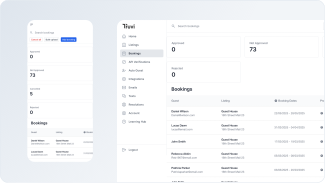
This is the point at which automated screening becomes the more practical answer to “how do I avoid a high-risk guest,” rather than a checklist to work through yourself. Truvi is the platform behind the data this checklist is built on. It applies the same weighting automatically on every booking, across every channel including direct, and pairs it with checks a manual process can’t easily replicate: matching every guest against a watchlist built from 800,000+ prior screenings, and verifying their email and phone are genuine rather than disposable. Each booking gets a risk score from low to critical based on the factors above, with the specific triggers shown in your dashboard so you can see why a booking was flagged, not just that it was.
None of this means rejecting every flagged booking outright, and Truvi doesn’t make that call for you. A potentially risky booking might be a reason to add another layer of verification, rather than your sign to automatically decline the guest. For instance, ID verification can be used to confirm the person booking is who they say they are, matching the guest’s photo ID against a live selfie.
For US guests, Truvi can run criminal background checks and sex offender screening add further scrutiny on select bookings, checking guests against 2,400+ databases and the national sex offender registry.
That’s the combination worth building toward: guest screening that tells you what you’re dealing with before check-in, based on the best available data. And backing that with damage protection gives you peace of mind in case something still goes wrong once they’re in.
Cut the guesswork. Get the best possible information: instantly.
Truvi applies these same risk factors automatically on every booking, across every channel, so the flagging happens before a guest ever checks in.