
Picture the scene. A guest checks out. They had a good time. You know they had a good time because they told you so, messaged to say thank you, mentioned they would be back. And then you spend the next 48 hours anxiously refreshing your review notifications, not because you’re curious what they thought, but because your listing’s algorithmic visibility depends on what score they leave.
That anxiety is not a personality quirk. It is the intended outcome of a system designed to keep you in exactly that state.
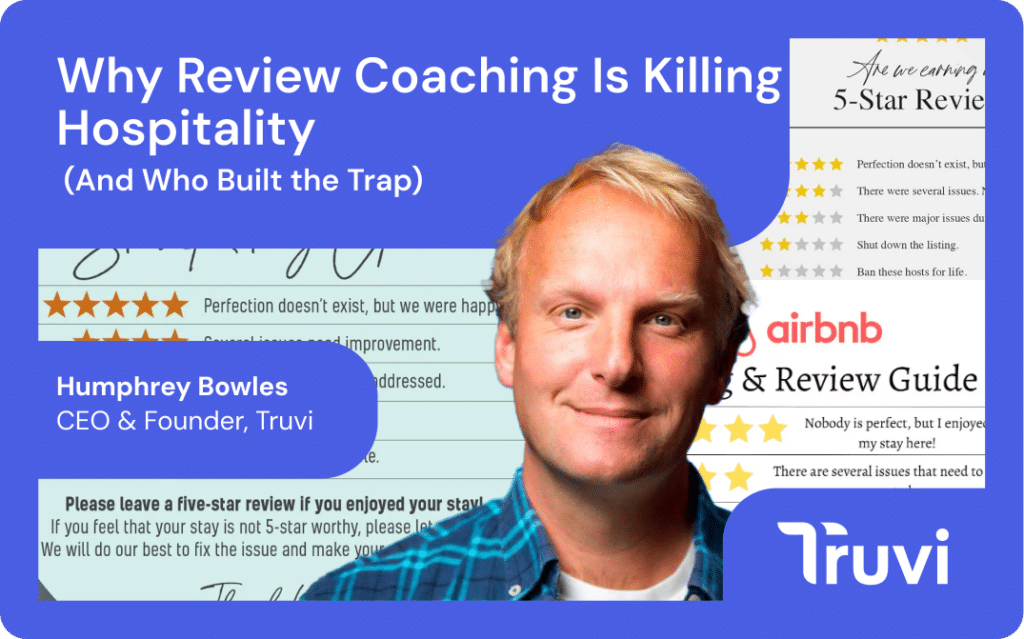
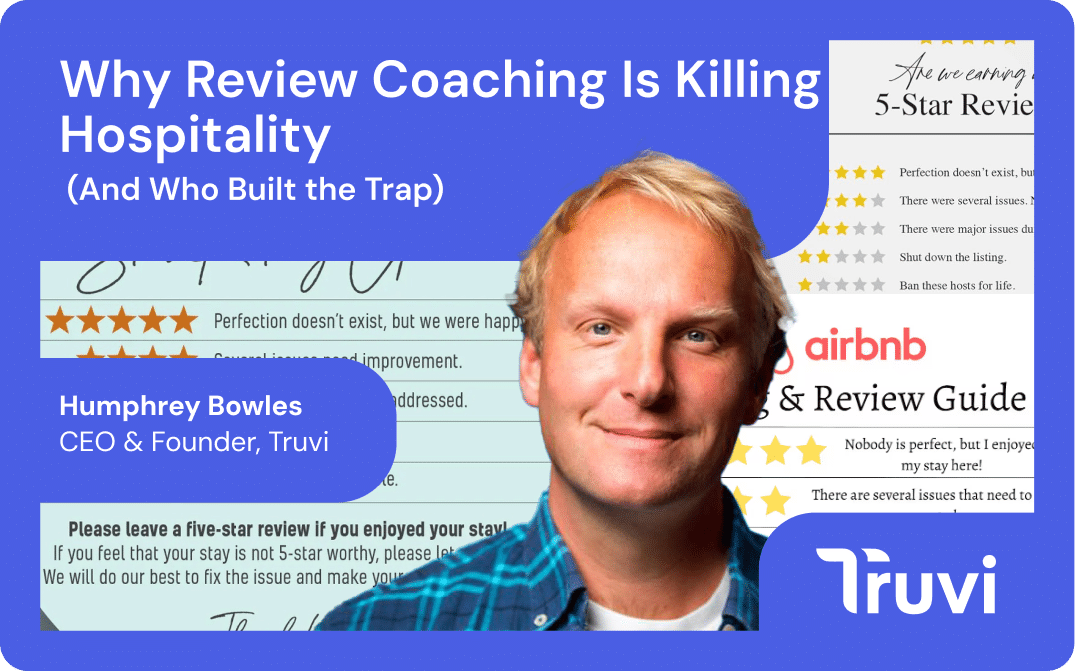
Pre-stay messages carefully worded to lower expectations just enough that the gap between reality and disappointment stays manageable. Post-stay follow-ups that do not ask how a guest’s experience was, but coach them toward the score you need. Posters on the wall explaining why their review matters to your livelihood. It has become so standard that most operators don’t question it anymore.
I think it is what capitulation looks like.
I joined Hailie Maarie and Steve Taggert for a webinar hosted by Damian Sheridan at SCALE recently, and this is the argument that kept surfacing, not as theory but as daily reality for people running real businesses under real pressure. Hailie told us her team now calls every guest during their stay, not (just) to check whether they are comfortable or whether anything needs fixing, but specifically to get ahead of a bad review before it lands.
Steve audits every property before the first booking goes live because he has learned, through painful experience, that a rough start on a new listing can be almost impossible to recover from algorithmically.
Both are great operators who care about guest experience and that’s exactly what makes it uncomfortable.

Why the Platforms Built It This Way
This didn’t happen by accident.
The platforms engineered a review system where a 4.2 triggers a “bottom 10% of listings” badge, where anything below 4.5 starts to erode your visibility, and where a single bad review from a guest who was never going to be happy can effectively kill a new listing before it finds its feet. They made reviews one of the primary inputs to algorithmic ranking, then watched as the entire industry reorganised itself around chasing a number.
The result is brilliant, if you happen to be running the platform: hosts living in anxiety stay obsessively engaged. Operators terrified of their score have no bandwidth to think about channel diversification or direct booking strategy. When your business hinges on maintaining a 4.8, you are not thinking about building guest relationships outside of Airbnb. You are thinking about that guest who checked out an hour ago and still has not left a review.
Steve spent a significant part of our conversation on what this looks like at the sharp end. Guests submitting AI-manipulated images as damage evidence. A complaint from a five-year-old booking being honoured with no warning, money taken from his account before he could say a word in his own defence, for a property he no longer even manages. When he tried to dispute it, he found himself talking to an automated system with neither the common sense nor the incentive to ask whether the complaint was actually fair.
This is what Hailie means when she says the system treats hosts as “guilty until proven innocent”, and it’s the inevitable result of a platform that has positioned itself as the arbiter of every dispute while having structural reasons to side with the guest. The platforms created these conditions deliberately, and they are not going to dismantle them voluntarily because the system is working exactly as intended.
What the Industry Has Normalised
There’s a version of this conversation that stays at the level of platform criticism, and I understand the appeal. The platforms deserve some scrutiny. But the more uncomfortable question is what we, as an industry, have agreed to accept.
Review coaching didn’t get imposed on operators from above. It emerged because individual operators, facing real algorithmic pressure, made rational decisions to protect their businesses. One person starts coaching guests toward five stars. Their competitors notice the reviews and start doing the same. Within a few years it’s standard practice, to the point where not doing it feels naive rather than principled.
What we have lost in that process is harder to quantify than a review score. The hospitality instinct, the one that asks “did this person have a genuinely good time” rather than “will this person leave five stars,” gets quietly deprioritised. The pre-stay message that once said “here’s everything you need to know about the property and the local area” now has a secondary purpose of managing expectations downward. The post-stay message that once invited honest feedback now steers guests toward a predetermined outcome.
Guests are not oblivious to this. They can tell when a property has been optimised for reviews rather than for the people staying in it. Steve made the point that you can arrive at a five-star property and find no cutlery in the drawer, because the host has learned that posters and coaching matter more to their score than operational basics. That’s what a broken feedback loop produces.
The Only Move That Actually Helps
Calling for fairer platforms is reasonable. I do it and I’ll keep doing it, but it’s not a strategy you can build a business on.
The only structural answer is to reduce how much any single platform controls your survival. When platform reviews are one signal among several, when you have direct booking capability and guest relationships that exist outside any OTA’s ecosystem, a bad review becomes damaging but not existential. You have room to absorb it, respond to it, learn from it without it threatening everything you’ve built.
Too many operators are currently in a position where a handful of reviews can determine whether a listing is viable. That is an extraordinary amount of leverage to hand to any single platform, and the review system is one of the primary mechanisms by which that leverage gets exercised.
Build toward a position where you’re not playing that game entirely on their terms. The platforms do one thing exceptionally well, which is distribution. Use them for that (as part of a diversified channel strategy, including direct booking). But your guest relationships and your reputation shouldn’t live entirely on someone else’s infrastructure.
Until that changes, we’re not optimising for hospitality. We are optimising for the appearance of it.
Stop relying on platforms to know who’s staying in your property.
Truvi’s guest screening gives you the intelligence to make your own decisions, across every booking channel, including direct bookings, so your protection doesn’t depend on whichever OTA sent you the reservation.




![Lodgify Reviews: Is Lodgify Right for Your STR Business? [2026]](https://truvi.com/wp-content/uploads/2025/06/Bookster-Review-1024x639.png)