
Guest screening is the process of verifying a guest’s identity and assessing the risk of a booking before you confirm the reservation.
The process used to be manual. As the industry has professionalised, screening has become mostly automatic, built directly into the booking journey through services like Truvi’s Guest Screening rather than run separately by hand.
Screening has become closer to standard practice than an optional extra, and the reason is what’s at stake when it’s skipped: fraudulent bookings, unauthorised parties, and property damage that only becomes visible once a guest is already checked in. This piece covers what a screening process actually checks, the red flags the data says are worth watching for, how it fits into an automated booking workflow, whether it holds up alongside Instant Book, and what it catches before it turns into a costlier problem.
What does guest screening involve?
A comprehensive screening process asks guests to submit their name, date of birth, home address, and a copy of an official ID such as a passport or driving licence. That information is checked to confirm the ID is genuine and that the details match what was submitted.
Guests also provide a phone number and email address, which get checked for signs they’re disposable or newly created for the booking rather than genuine, ongoing contact details.
Many providers add a biometric or liveness check, usually a selfie or short video, to confirm the guest matches their ID photo. Some also verify payment details to catch stolen cards or mismatched billing information before the stay begins.
The depth of a screening process varies by provider. Some stop at ID and contact verification. Others go further, adding background checks against criminal databases and watchlists as part of a full guest screening process for vacation rentals.
Put together, a full screening process typically covers:
- Name and date of birth
- Home address
- Copy of official ID
- Phone number and email verification
- Selfie or video for a biometric check
- Payment verification
- Background and watchlist checks, where applicable
Red flags to watch for
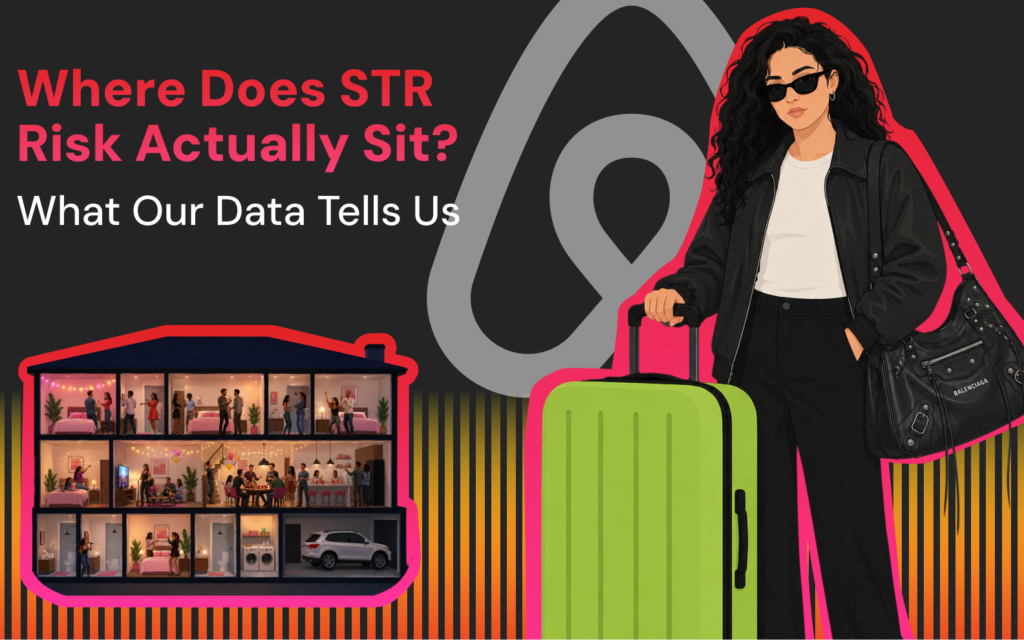
No single signal guarantees a bad booking, but certain patterns are worth a closer look before confirming a reservation. Our analysis of 90k+ completed bookings points to a few that matter more than instinct alone would suggest.
Property size
Property size is the strongest single risk factor in the data. Larger properties, particularly those with seven or more bedrooms, see incident rates well above the average for smaller properties.
Guest age, proximity, and lead time
Younger guests, bookings from guests who live close to the property, and same-day or last-minute bookings each carry a higher incident rate on their own, and the effect compounds when more than one is present. A young guest booking a large property nearby is a meaningfully different risk than any single factor in isolation.
Stay length
Stay length matters more than most operators assume. Risk climbs sharply past ten nights, with the highest lift seen in stays of three to four weeks. Short stays tracking close to average and long stays reading as low-maintenance is a common assumption the data doesn’t support.
Behavioural signals
Beyond the data patterns, the usual behavioural signals still apply: guests who won’t provide ID, mismatched details between the booking and the payment method, requests to communicate or pay outside the platform, and unfamiliar or reviewless accounts booking premium properties.
None of these signals are disqualifying on their own. What matters is having a consistent process that checks for them on every booking, rather than relying on a gut feeling that varies from one reservation to the next. It also gives you the paper trail needed to hold a guest accountable if something does go wrong, and it’s one part of a broader approach to consistently attracting good guests in the first place.
How guest screening fits into the booking workflow
Screening runs automatically once a booking comes in, without asking the guest to do anything extra before they book. The check happens between reservation and check-in, usually within minutes, and the result appears as a status in your booking report rather than a manual task on your list.
This is typically handled through an API-based integration rather than a separate portal. Many property management systems connect directly to a screening service, so the check happens as part of the existing booking flow instead of running as a separate step the host has to trigger.
That matters operationally because it means screening scales with your portfolio. Whether you’re managing five bookings a month or five hundred, the process doesn’t get heavier. Flagged bookings surface for review, and everything else clears without anyone touching it.
Guest screening with Instant Book
A common concern with Instant Book is that adding screening will slow bookings down or introduce friction that costs conversions. In practice, automated screening runs after the booking lands rather than before, so it doesn’t interrupt the instant confirmation guests expect.
The check happens in the background: the reservation confirms instantly, screening evaluates it in parallel, and anything that crosses a risk threshold gets flagged in your dashboard for review. You get the booking volume Instant Book is designed to deliver, without giving up visibility into which of those bookings need a closer look.
What guest screening actually catches
The value of screening shows up most clearly in what it prevents rather than in the process itself.
Fraudulent bookings made with stolen cards or fake identities often aren’t discovered until weeks later, when a chargeback hits the account. By then the guest is long gone and the cost is already sunk. Screening catches the signals that lead to that outcome earlier: mismatched payment details, contact information that doesn’t hold up, and booking patterns that don’t match a genuine guest, all flagged before the reservation is confirmed rather than after the damage is done.
The same logic applies to unauthorised parties and property damage. The risk factors covered above, like property size, proximity, and lead time, rarely show up as one obvious red flag on their own. Screening evaluates them together at the point of booking, when there’s still time to flag the reservation, rather than leaving a host to piece it together only after a group has already arrived.
What screening feels like for guests
A well-built screening process protects the property without guests noticing much of a difference. Most complete the ID and contact verification step in a couple of minutes, generally through a link sent automatically after booking, and results come back quickly enough that it rarely holds up their planning.
Guests are, on the whole, used to this. It’s a similar ask to checking in at a hotel or picking up a rental car. The friction that does exist tends to fall on the small number of guests who are reluctant to verify who they are, which is itself a useful signal.
Do OTAs screen guests for you?
Airbnb runs ID verification at account creation but shares only limited guest details with hosts, which puts real limits on what property managers can see before check-in. Vrbo encourages guests to earn a Verified Identity badge rather than requiring one, so screening stays optional rather than a condition of booking. Booking.com leaves it almost entirely to hosts through optional guest requirements that hosts set themselves rather than anything the platform enforces automatically. None of the three run the kind of background or watchlist checks a dedicated screening process provides, and that gap applies fully to direct bookings, where none of this platform-level infrastructure exists at all.
Truvi guest screening
Truvi runs automatic screening on every booking: watchlist checks against guests with a history of unpaid damage, email and phone verification to catch disposable or fraudulent contact details, and instant results in your booking report as Approved, Flagged, or Rejected. It works the same way across every channel, OTA and direct alike, so protection doesn’t depend on which platform sent the booking.
For properties or portfolios that need more, Truvi also offers ID verification, criminal background checks against 2,400+ US databases, and sex offender registry checks against the US National Sex Offender Registry as add-ons. Pair screening with Truvi’s damage protection, covering up to $1M per incident, and you’ve got a system that catches risk before check-in and covers you if something still goes wrong.
Truvi is insurance-backed, not an insurer, and every transaction is GDPR-compliant.
Screen every booking before it becomes a problem
Truvi runs automatic guest screening across every channel, so you know who’s actually booking before you hand over the keys.