
Starting a short-term rental business comes with plenty of perks, from the high average ROI to the added flexibility you’ll have to use your property, even for your own personal holidays.
So if you’re looking at investing in property, Airbnb is still a way to go. And just like many other types of lucrative businesses, this one requires an STR license.
Across the US, city and state regulations for short-term rentals vary. Depending on where you are, you may or may not need a license to run a holiday rental business. Beyond licenses, there are also numerous city and state-specific rules you may need to comply with – all of which affect how you run your property in the day-to-day.
If you want to know where to start when it comes to Airbnb license requirements – including how to apply for Airbnb licenses across the US – let this article be your guide. We’ll cover the specific license requirements in several major US cities and states before taking you through the steps you’ll need to follow to comply.
Key Takeaways:
- STR licensing requirements vary significantly by city and state across the US
- License fees typically range from $50-$1,000 annually, but fines for non-compliance can reach $10,000+
- Some cities, like NYC, prohibit entire-unit rentals under 30 days unless the host is present
- You may need both a business license AND an STR permit in certain jurisdictions
- Always check local regulations before listing your property — requirements change frequently
- Operating without required licenses risks hefty daily fines and removal from platforms
What is an STR license?
A short-term rental business license, aka “Airbnb license,” is a document that authorizes you to legally set up and run an Airbnb, holiday rental, or equivalent within your local jurisdiction.
Short-term rental licenses assist local governments with controlling how many short-term rental properties operate in a particular area – and how they operate. That’s why you may be required to prove that your rental complies with local regulations when you apply.
The short-term rental license application process varies in different jurisdictions, but it’s probably the case that you’ll have to fill in a bit of paperwork and pay a fee. You may need to provide official documents to prove compliance, and in some cases, your property may be inspected too.
If you’re new to the entire discourse, it’d be helpful to define what a short-term rental is.
STRs are properties that are rented out to tenants for short stays. Typically, it’s only days or weeks at a time.
Unlike long-term rentals (LTRs), STRs typically host temporary travelers. They’re perfect for guests who might want to enjoy a quick weekend away or a longer holiday in a new city.
Short-term rentals are used for purposes other than holidays, too. STRs are sometimes preferred for business travel as an alternative to a hotel. Check out our article on how to start a short-term rental business for a bit more info.
Short-term rental licenses vs permits
Although the terms license and permit are often used interchangeably, they don’t always mean the same thing.
A short-term rental license might not be enough to run your business legally in certain cities and states.
In some parts of the US, a license and a permit are two separate requirements for short-term rental business owners. It’s important to read the regulations pertaining to your local area to understand whether you need both before you set up your business.
Do you need a license to run an Airbnb in the US?
STR licenses are a necessary requirement for running a short-term rental in several US cities – but not all of them.
Getting to know your local licensing requirements can be an important early step in creating your business plan. So, before you start out, make sure to do your homework first.
Take a good look at the short-term rental (STR) regulations you’ll need to follow.
Also, factor in license fees, permits, and other regulatory costs into your budget. You’ll also want to have a good handle on how your business will be allowed to operate before you get it up and running.
Take a look at our analysis of the best Airbnb markets in the US. And here are some ideas for the best places to buy a second home in Europe, just in case.
Can you operate without a license?
Before we go any further, let’s address one more point about the necessity of an Airbnb license. Even if local regulations specify you should have one, do you really need a license to Airbnb your property? As in, really need?
In some cities, like New York, you simply won’t be able to list your property on Airbnb without being registered. In other places, not applying for a license when you need one is a decision with consequences, just like driving a car without a license. Get caught without one, and you may face serious fines, or worse.
And even if you don’t get caught, running a rental property without a license doesn’t look great for potential guests.
A license is a way of showing that your property meets the health and safety standards it needs to, which helps to keep tenants safe and can put everyone’s minds at ease during a stay. It’s also a sure sign that you’re a host they can trust.
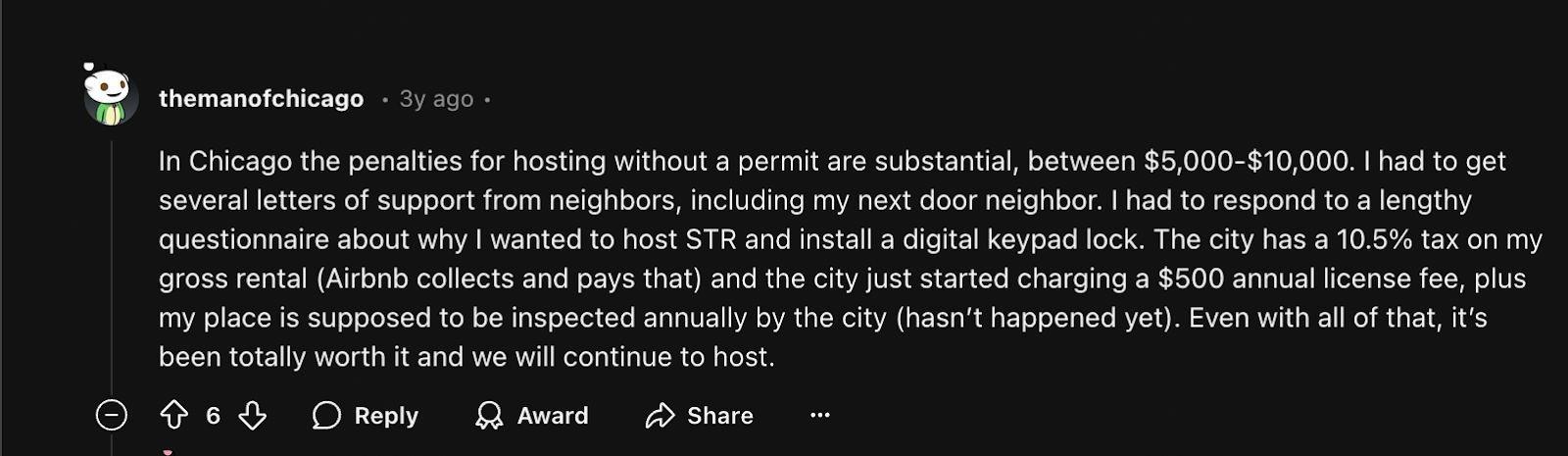
License fees aren’t typically too costly – most of them sit around the $200 mark per year. But fines are certainly steep. Some cities will charge a fine that accumulates every day that guests stay illegally. In Texas, this fine can be up to $2000 per day. We’d all rather not do the math on that one. All in all, it isn’t worth the risk.
Which US states require a business license for Airbnb?
Licensing requirements are location-dependent. If you’ve already bought a property or have a particular location in mind, one of the best ways to know if you need a license to run your Airbnb is to read the rules posted on local government websites. That way, the information you need will be in one place and up to date.
But if you’re yet to buy a property, you might also want to consider licensing requirements before you decide on where to run your Airbnb. This is because some requirements are stricter than others – and they may affect how you run your business in a significant way.
You might want to run your property in a city where regulations are a little less strict, even if that means less demand for stays. It all depends on your budget, lifestyle, and overall business plan – so make sure to start thinking about these earlier rather than later.
For a comprehensive overview of regulations in major cities, check out our guide to Airbnb regulations by city. Below, we’ll cover the specific requirements for some of the most popular STR destinations.
STR rules in New York City
We go into New York’s Airbnb regulations in more detail, but here’s what you need to know for licensing. In the city that never sleeps, you’d be wise not to sleep on applying for a short-term rental license. Violations can result in fines up to $5,000.
Property managers need to register with the Office of Special Enforcement (OSE). Hosts here are prohibited from renting entire units for fewer than 30 days, unless they are also present at the property during the stay.
Only two guests are allowed per rental, and listings in public housing or rent-controlled units are prohibited.
Licensing requirements include proof that the property is the host’s primary residence and is in compliance with other regulations. Registration costs $145 annually.
Do I need a business license to run an Airbnb in New York?
In New York City, even though you do need a short-term rental license to operate, there are some cases where you do not need to apply for an additional business license.
Short-term rental operators must register as a business if they operate multiple listings or earn significant income from their listings. Check their website to determine whether your property qualifies as a business – and if it does, you’ll need a license.
Do you need a license to do Airbnb in Denver?
We go into Denver’s Airbnb rules in a bit more detail in this article, but the short answer is yes. Denver requires a short-term rental license for all primary residences listed on platforms like Airbnb.
The application fee is $50, and renewals cost $100 annually. Hosts must comply with zoning laws and safety requirements. Operating without a license incurs fines ranging from $150 to $999 per violation.
San Francisco Airbnb rules – do I need a business license for Airbnb?
For a complete breakdown of San Francisco’s Airbnb rules, check our detailed guide. A Business Registration Certificate is mandatory for all Airbnb hosts in San Francisco.
Property managers must register with the city and obtain a certificate for $91 annually.
You’ll also need to pay a $450 registration fee to the Office of Short-Term Rentals. Fines for non-compliance are steep, getting up to $1,000 per day.
Do you need a real estate license for Airbnb businesses in Las Vegas?
The answer is yes – and you’ll need a general business license too. You can read more about Las Vegas Airbnb laws in our comprehensive guide, but here’s a breakdown.
Costs for short-term rental licenses begin at $500 here, and strict zoning laws prevent STRs in certain residential areas.
Violators face fines starting at $1,000 and up to $10,000 for repeat offenses.
Do I need a license for Airbnb in San Diego?
San Diego uses a tiered system for licenses, which you can read about in more detail here. Type 1 permits allow up to two short-term rental licenses per host and cost $1,000, while Type 2 permits for non-primary residences are subject to availability via a lottery system.
Violations can result in fines of $1,000 per incident.
What type of business license do I need for Airbnb in DC?
In Washington, DC, the type of business license you need to operate an Airbnb depends on the nature of your rental.
If you are renting out your primary residence – as in, a home you’ll share with prospective tenants – you’ll need a Short-Term Rental License. This license allows you to host guests for stays of fewer than 30 consecutive nights. If renting out your primary residence for extended periods when you’re not also living there, you’ll need a Vacation Rental License.
To obtain either license, you must register your property with the DC Department of Consumer and Regulatory Affairs (DCRA), ensuring the rental property complies with local zoning laws, safety standards, and tax collection regulations.
Licensing across the world
Just like they vary from state to state, Airbnb business license rules are also different across the globe. And they’re always changing.
Since October 2022, Scotland has had a mandatory licensing scheme for short-term lets. Local councils have the authority to designate “Short Term Let Control Areas,” where specific rules apply.
The looming Barcelona Airbnb ban announced and supported by Mayor Jaume Collboni will result in banning short-term rental licenses in central parts of the city by November 2028.
Do you need a permit for Airbnb in the UK?
For detailed information about UK Airbnb legal requirements, including planning permissions and tax obligations, see our complete guide. UK licenses and requirements are significantly different from those in the US.
Depending on where your property is located, you may or may not need to apply for a license or planning permission.
How can you get a short-term rental license?
Once you’re sure about the regulations and licensing requirements in your area, the next step is learning how to apply.
If licenses are required in your jurisdiction, make sure to apply well before you begin advertising your property online. Allowing plenty of time means you won’t risk opening your doors to guests before all the necessary paperwork has been processed and returned to you.
For Airbnb permit applications across the US, the process varies, but we’ll outline some of the most common steps below:
- Check eligibility: First off, review zoning regulations to determine how your property is affected.
- Make an online account: You may need to make an account on an official government website before you lodge an application. In New York, for example, the first step you’ll need to complete is registering on their short-term rental application portal.
- Prepare documents: You may need to provide proof that the property is your primary residence, as well as demonstrating tax compliance.
- Register your business: In several cities, you will need to apply for a separate business license before you apply for your short term rental permit.
- Submit relevant documents: Your lease, proof of ownership, utility bills, insurance papers, and floor plans may be required as proof of compliance.
- Prepare for an inspection, if necessary: The city may require property inspections for safety compliance.
- Pay the application fees: These may be paid as a one-off cost or annually, depending on your location. Fees can range from around $25 to more than $1000.
- Await approval: Approval may take several weeks while applications are reviewed.
Recieve registration number or license: Upon approval, you may receive a registration number, which you include in your Airbnb listing. Once you have obtained this, or your official license, you can begin to operate legally.
Getting your STR license: the foundation of a successful rental business
Getting the right licenses for your short-term rental business isn’t optional — it’s essential for legal operation and protecting your investment. Requirements vary dramatically between cities and states, from simple annual registrations to complex permit systems with property inspections.
The key is researching your local requirements early in your planning process. License fees are typically manageable (usually $50-$1,000 per year), but the consequences of operating without proper permits can be devastating. Whether you’re running a single property or building a portfolio, staying compliant with licensing requirements protects both your business and your guests.
Ready to operate your licensed STR with confidence?
Protect your properties with Truvi’s Guest Screening and Damage Protection. Screen guests before they book and get up to $1M protection for any damage that occurs.