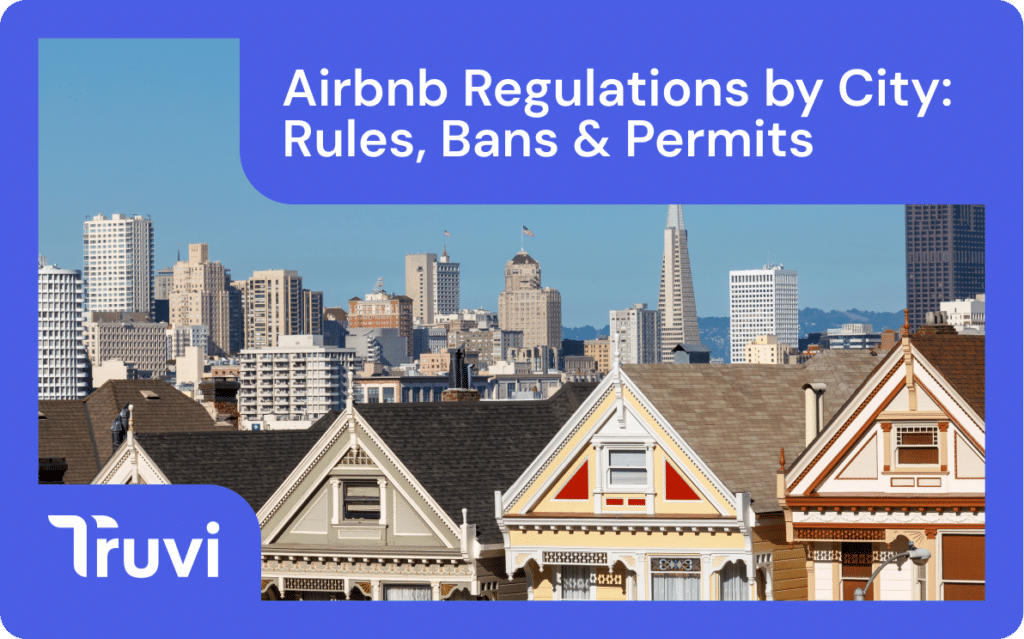


TL;DR: San Francisco is one of the most lucrative – and most regulated – Airbnb markets in the US. Hosts must register with the city, live in their property for at least 275 nights a year, limit unhosted rentals to 90 days annually, and maintain $500,000 in liability insurance. Quarterly reporting, zoning restrictions, and a $925 registration fee add further complexity. Understanding these rules upfront is essential before listing in SF.
The average Airbnb price per night in San Francisco is US $392*, making it the highest in the entirety of the US. With occupancy rates of up to 69%**, renting your San Francisco property on Airbnb can be lucrative.
And yet, the city is known for having complex short-term rental laws that could appear daunting to an Airbnb host. These include a 90-day rental limit, permanent residency requirements, registration rules, and an insurance minimum of US $500,000.
These rules have seen the number of Airbnbs plummet to just over 8,000 as of early 2024, compared to around 40,000 in other major US cities like Los Angeles and New York***.
To give you a head start, we’ve outlined the main need-to-know SF Airbnb rules and laws. You’ll also find tips on how to protect your home from dishonest guests and damage. This guide will help you work out which San Francisco Airbnb regulations apply to you, and start Airbnb-ing your home with ease.

What are the registration requirements for Airbnb in San Francisco?
If you want to rent your property out for fewer than 30 days at a time, you need to register it as a short term rental directly with the City of San Francisco.
San Francisco Airbnb Compliance Checklist
Step 1: Confirm primary residence
☐ Already lived there for 60+ days (registration eligibility)
☐ Live there for 275+ days/year (ongoing requirement)
Step 2: Register your business
☐ Apply for Business Registration Certificate
☐ Get Business Account Number (BAN)
Step 3: Apply for STR Registration
☐ Apply with San Francisco Planning Department
☐ Pay $925 fee
Step 4: Provide required documents
☐ Proof of residency
☐ Government-issued ID
☐ Insurance coverage ($500,000 minimum)
Step 5: Follow rental limits
☐ Entire home: max 90 unhosted days/year
☐ Partial rental: unlimited (if host present)
Step 6: Stay tax compliant
☐ Collect 14% Transient Occupancy Tax
☐ Report Business Personal Property tax
What documents do you need?
For your home to be considered a short-term rental, you must register for:
- A Business Registration Certificate, issued by the San Francisco Office of the Treasurer & Tax Collectors
- A Short-Term Rental Registration Certificate
Eligibility requirements
San Francisco has a primary residency rule designed to protect long-term housing availability and maintain neighbourhood character across the city. This can be a major hurdle to property owners wanting to grow an STR business there.
Here’s what’s required to be eligible:
- You must live there: You must be a permanent resident in the unit you’re renting for at least 275 nights per year. If you haven’t lived there a full year yet, you must have occupied it for 75% of the days you’ve been there.
- 60-day rule: You can only register if you’ve already lived in the unit for 60 days.
- One unit only: You can only register the specific unit where you live, rather than a second home or investment property.
- You must observe rental limits: Partial renting (e.g. one bedroom) while you’re still present isn’t limited. However, you may only rent out the entire space for a maximum of 90 days per year when you’re not present.
How to register
To start your application online, visit San Francisco Planning. You’ll need:
- $925 non-refundable registration fee
- Your Business Registration Certificate or proof you applied for one
- Proof of residency, i.e. two documents like a government-issued ID, homeowner’s tax exemption proof, utility bill, or Voter Registration Card
- Proof of insurance for at least $500,000 (not required if you list exclusively on Airbnb, since the platform provides coverage)
You may also need a safety inspection during the application review. Once you’ve applied, you must include your application record number on all listings (e.g. in the format: 2023-123456STR). Once approved, update your certificate number (e.g. STR-0001234).
Your certificate is valid for two years before renewal. If your application is rejected, you can file a written appeal within 30 days.
And if you’re thinking about expanding your STR business, here are the Airbnb regulations by city.
What zoning laws do Airbnb hosts need to know about in San Francisco?
Thanks to zoning laws in San Francisco, some properties in certain locations aren’t eligible to become short-term rentals. You can see an interactive map and search a list of these zones on the San Francisco Property Information Map.
Certain zones have extra short-term rental regulations, too. For example, if your unit is located in a zoning district identified as “RH-1(D)”, the Office of Short-Term Rentals will send a notice to all property owners and residential tenants who live within 300 feet of your unit.
They’ll receive the notice once you submit your short-term rental registration application. Then, they have 45 days to submit comments to the Office of Short-Term Rentals. However, these comments will only hinder your application, especially if someone is able to submit good evidence that you or your unit is ineligible to host short-term rentals.
You can check if you are in a RH-1(D) area on the same map above.
What taxes apply to Airbnb in San Francisco?
There are two kinds of taxes that apply to Airbnbs and short-term rentals in San Francisco. Bear in mind that these taxes apply on top of the fees you’ll pay when registering and renewing your business.
Transient Occupancy Tax
Hosts must collect a Transient Occupancy Tax (TOT) from guests, for all rentals that last less than 30 days. This is currently 14% of the total rent. This tax must then be paid to the San Francisco Treasurer & Tax Collector. Hosts must have a Certificate of Authority (issued by San Francisco Treasurer & Tax Collector’s Portal) to collect this tax.
Business Personal Property Tax
This tax is calculated based on the furnishings, appliances, and other personal items used in the rental business. These items must be reported to the Tax Collector via the host’s Business Account Number (BAN), which is given when the business is successfully registered.
What are the rules for multi-unit buildings for Airbnb in San Francisco?
Multi-unit buildings in San Francisco are covered by a number of extra regulations. As an Airbnb host, you’ll need to know these rules:
Accessory Dwelling Units (ADUs)
ADUs are smaller, stand-alone (detached) residential units located on the same property lot as the main home. These are sometimes known as “granny flats”, “annexes” or “secondary suites.”
In San Francisco, ADUs are not eligible for short-term rental, as outlined by the San Francisco Planning authority.
The Ellis Act and affordable housing
Dating to 1985, the Ellis Act is a California state law that enables landlords to evict residential tenants from their property if the landlord wishes to exit the rental market completely. In San Francisco, if a landlord invokes this law, they must comply with laws on affordable housing.
Any property subject to an Ellis Act eviction after 2014 is not eligible for short-term rental.
Hosts in San Francisco cannot operate several Airbnb units at once, because they must live in the listed property for at least 275 days per year. This is only possible to do in one, main residence.
What are the insurance requirements for Airbnb in San Francisco?
Hosts in San Francisco must maintain at least $500,000 of liability insurance, and show proof of this when submitting their Short-Term Rental Registration Certificate application.
Airbnb offers Host Liability insurance that satisfies this requirement, but it only applies to stays booked through Airbnb. If you list on any other platform or take direct bookings, that protection doesn’t follow you.
Listing across channels helps guests find your property and keeps your income stable. But it’s important to understand whether liability insurance is included or if you need to look into other options. Taking direct bookings can mean you save on platform fees, but only if you’ve got good value cover.
It’s also worth noting that Airbnb’s Host Liability isn’t the same as damage protection. It doesn’t cover property damage, fraud, or problem guests the way dedicated short-term rental damage protection services will. To compare your options, check out our guide to the best Airbnb host insurance.
What compliance checks apply to Airbnb in San Francisco?
As if paying additional taxes and applying for all the correct registration documents wasn’t enough, there’s more you need to know. To stay compliant as a short-term rental host in San Francisco, you must:
- File reports four times a year. This must be done in January, April, July, and October via the Quarterly Rental Reporting Portal, at the City’s Office of Short Term Rentals. You must share the number and dates of short-term rentals of your unit.
- Maintain records. You must keep records that prove your primary residence in the unit, show how many days per year you occupy the unit, and indicate the number and dates of short-term rentals of your unit.
- Clearly display safety precautions. You must affix a clearly printed sign inside your unit, on the inside of the front door, providing information about the location of all the fire extinguishers in the unit and building, the location of all gas shut off valves, the location of fire exits, and fire alarms.
- Accessibility and fire safety. All properties rented short-term must comply with building standards, accessibility code, and fire safety regulations, to ensure the safety of occupants. Not complying with these standards may see your authorization revoked, and could also void your insurance policy.
Are there any other regulations or penalties Airbnb hosts need to know about in San Francisco?
San Francisco has some of the strictest STR regulation in the country. Keep these rules in mind when you list your properties:
No code complaints
San Francisco law states that hosts may only rent out their property or unit if there are no unresolved building, housing, or planning code complaints that apply to the space.
Hosted vs. unhosted listings
If you operate both “hosted” rentals (e.g. renting out one bedroom in your wider home) and “unhosted” ones (e.g. renting out your entire home when you’re not present), you must create separate listings for each. One listing will be covered by the 90-day limit, and the other will not.
Contract clauses
You must follow any other rules or contracts you’ve signed or are bound by in the building. This could include rules dictated by a lease, condo board, HOA, co-op, or tenant organization.
Leaseholder rules
If you don’t own the building, or have a lease, you may need permission from your landlord or leaseholder to operate the property as an Airbnb. You’ll need to check your lease, agreement, or contract to be sure.
Eligibility
To become a short-term rental, your unit must be permitted and designed for residential use. Your unit cannot:
- be a commercial or industrial unit
- be in The Presidio, Fort Mason, or Treasure Island districts
- be a Single-Room-Occupancy (SRO) or dormitory
- be a Below-Market-Rate (BMR) or Public Housing unit
- be an Accessory Dwelling Unit (ADU)
- have sleeping quarters for guests or hosts in outdoor areas, including treehouses and vehicles, or in a separate detached structure.
Got properties in other places? Browse our guides:
- STR Regulations Global Overview
- Las Vegas Airbnb Laws
- Denver Airbnb Rules
- San Diego Short Term Rentals Laws
- Dallas Airbnb Rules
- Atlanta Airbnb Laws
- Seattle Short-Term Rental Laws
- San Jose Short-Term Rental Laws
- New Rules For Holiday Lets in The UK
- Barcelona Airbnb Ban
Safeguarding your short-term rental business
Operating Airbnbs in San Francisco is challenging even for experienced property owners.
It comes with strict regulations, including limits on “unhosted” stays, permanent residency requirements, zoning restrictions, and mandatory insurance. To comply, hosts must register, report rental activities quarterly, and adhere to safety and zoning laws.
When you’ve put so much effort into compliance and paperwork, the last thing you want is a bad experience with a guest draining your profits and adding unnecessary stress. Especially when that guest is actually staying in your primary residence.
With Truvi, damage protection is included when you use our guest screening service. It’s automatically applied to every booking, making sure you’re protected from accidental and intentional guest damage.
Open your door to guests you can trust
Keep your home safe with comprehensive guest screening and up to $1M damage protection
*Statista, February 2024. **Airbtics.com, 2024. ***Airbnb.com and Statista, 2024.