
TL;DR San Diego requires all STR hosts to obtain a Short-Term Residential Occupancy (STRO) license under a four-tier system based on whether it’s your primary residence and how many nights you rent. Tier 1 (up to 20 days/year, $226) and Tier 2 (primary residence, $317) have no caps. Tier 3 and 4 (whole-home rentals 20+ days/year, $1,170) are capped at 1% of city housing stock – with fewer than 900 licenses remaining citywide as of late 2025. Mission Beach has a separate 30% cap and uses a lottery system; the waitlist is currently closed. Licenses are non-transferable, run for two years, and you can only hold one at a time. On top of licensing, you’ll pay TOT (11.75-13.75% depending on zone) and RUBT annually, plus comply with Good Neighbor standards including 24/7 local contact, noise enforcement, and safety equipment. High barriers to entry make guest screening critical – you can’t afford fines or neighbor complaints when licenses are this expensive and difficult to obtain.
San Diego operates one of the most regulated short-term rental (STR) markets in California. These regulations come as a compromise after a “drawn out battle” between those who are anti short-term rental, and those who are pro property owner rights, says Paul Becker, a member of San Diego Short-Term Rental Alliance.
Whether you’re a host trying to keep an existing property on the right side of the rules, or an investor weighing up the market, San Diego’s short-term rental regulations have real implications for the future of your business.
This guide breaks down the latest ordinance, including the four-tier licensing system, recent tax changes, and Good Neighbour compliance obligations. Throughout, you’ll hear from Paul, who has navigated this market for over a decade and knows better than most what the regulations mean in practice.
What are San Diego’s short-term rental regulations?
San Diego’s decision to limit STRs has dramatically altered the local real estate scene. “The city allowed short-term rentals to exist. However, they capped the number for whole-home short-term rentals at 1% of the available inventory in San Diego,” says Paul Becker, founder of a property management company called Blue Water Vacation Homes.
Here’s what you need to know about the STR regulations in San Diego:
- You must obtain a Short-Term Residential Occupancy (STRO) license under San Diego’s four-tier licensing system. You’ll find more details about each tier below.
- Whole-home licenses are capped meaning there’s a limit to how many STRs can operate in the city.
- You can only hold one STRO license at a time, which means you can’t operate multiple STRs within city limits.
- Licenses run for two years and all fees are non-refundable. Be sure to confirm your property qualifies before you apply, as you won’t get your application fee back if you’re unsuccessful.
- Your building rules could prohibit STRs even if the city approves you. If you’re in a condo or Homeowners Association (HOA), check your Covenants, Conditions & Restrictions (CC&Rs) before applying for your license.
- STRO licenses aren’t transferable from host to host or property location. If you sell your property, the license doesn’t pass to the new owner.
Check out Airbnb regulations by US city to see how San Diego compares to other markets.
Which San Diego STR licensing tier applies to you?
There’s no way around it, you need STR license to list your San Diego property on Airbnb, Vrbo, or any other vacation booking platform.
San Diego operates a a four-tier STR licensing system based on two questions:
- Is this your primary residence?
- How many nights a year do you plan to rent it out?
Your answers determine your tier, your fees, and — crucially — whether you can even get a license at all. So, let’s find out which tier applies to your property:
Tier 1: Part-time rentals (up to 20 days per year)
Tier 1 is for infrequent hosts who aren’t present during guest stays. This applies to you if the property isn’t your primary residence and you won’t be renting your place out full time. For example, the property might be your family vacation home or a place you want to test the market on before committing.
There’s no citywide cap on Tier 1 licenses, so availability isn’t an issue. As of March 2025, the total cost is $226 USD ($33 application fee + $193 license fee), covering a two-year license period.
- Booking frequency: up to 20 days/year
- Primary residence? No
- Cap on the number of licenses? No
- Total license cost: $226
Tier 2: Home-sharing (primary residence, any frequency)
Tier 2 is for hosts who rent out their primary home. To qualify, the property must be where you live for no less than 275 days of the year, which is about nine months.
You’ll either rent out a room while you’re present in the property, or you’ll rent out the whole place when you’re away. This is ideal if you have spare rooms you don’t use or you travel a lot but don’t want your place to sit empty when you’re not there.
Like Tier 1, there’s no licensing limit, so you can apply anytime. Provided your property is eligible, you should get approved. The total cost is $317 ($33 application fee + $284 license fee).
- Booking frequency: Any
- Primary residence: Yes
- Cap on the number of licenses? No
- Total license cost: $317
Tier 3: Whole-home rentals outside Mission Beach (20+ days per year)
Tier 3 is mostly for property investors and professional property managers. It covers non-primary residences rented for more than 20 days per year. Quarterly reporting to the city is required and guests must stay for a minimum of two nights.
Licenses are capped at 1% of San Diego’s housing stock — that’s roughly 5,400 properties citywide. As of late 2025, there were fewer than 900 licenses remaining. Once that number hits zero, new applicants will have to wait for existing operators to give up their licenses.
The cost jumps significantly here: $1,170 total ($41 application fee + $1,129 license fee), reflecting the city’s view that these properties have the greatest impact on housing availability.
- Booking frequency: 20+ days per year
- Primary residence: No
- Cap on the number of licenses? Yes
- Total license cost: $1,170
Tier 4: Whole-home rentals in Mission Beach (20+ days per year)
Similar to Tier 3, but for Mission Beach only. This area has a separate cap set at 30% of the neighborhood’s housing stock (around 1,080 properties). As of March 2026, the waitlist for new licenses is closed. You may be able to apply for license when it re-opens, but applications are selected on a lottery system rather than first-come first-served.
You’ll pay $41 application fee + $1,129 license fee, and you’ll be expected to report to the city quarterly. Guests must stay for a minimum of two nights.
- Booking frequency: 20+ days per year
- Primary residence: No
- Cap on the number of licenses? Yes
- Total license cost: $1,170
What you need to know about Mission Beach Tier 4 licenses
With its own licensing tier, Mission Beach illustrates the real-world impact of STRO ordinance more than any other neighborhood in San Diego. For Paul, the license cap and non-transferability regulations go against the rights of property owners.
“If you’ve registered, you’re paying taxes and a license fee and you’re a good neighbour, you should have the right to rent out your home short-term,” he says. “The cap was introduced to appease our opponents.”
He also feels that the strict regulations don’t address San Diego’s housing crisis. “A lot of people don’t want to live [in Mission Beach] long-term because it’s a vacation and a college community.” That makes it difficult to use properties for anything other than STRs.
But the city policy isn’t changing any time soon. If you’re considering operating in the area, you’ll need to understand how Tier 4 licenses work for Mission Beach properties.
Mission Beach STR license cap
For properties in Mission Beach, you’ll need a Tier 4 license. However, the number of licenses available is capped at 30% of the neighbourhood’s housing stock (that’s around 1,080 properties).
As of March 2026, all Tier 4 licenses have been issued. The cap has been reached and the waitlist is closed. The city will only reopen applications once the existing waitlist has been fully exhausted, meaning licenses become available only when current holders don’t renew or have their license revoked for violations. There’s no timeline for that, and no new application window has been announced.
When a new window does open, licenses aren’t awarded on a first-come, first-served basis. A random lottery determines waitlist position, and the city prioritises hosts with a clean compliance history. If you have pending enforcement actions against you, you won’t be considered.
Non-transferability regulations
You may remember that STRO licenses are non-transferable, which is vital to know if you’re considering buying or selling property at Mission Beach. Paul explains that, when an owner with a popular STR property sells their property, they can’t transfer their license to thew new owner.
Given the license lottery for Mission Beach, new owners are essentially forced to use their property for mid or long-term rentals. According to Paul, the neighbourhood isn’t very desirable for long-term tenants, which affects the value of the property.
His property management business also loses out when a home-owner who has been on the books a long time sells their property. In the past, the owner would recommend Paul’s property management services on, transferring those revenue streams and repeat guests to the new owner. Now, the company loses that inventory.
What happens if you can’t get a Tier 4 license in San Diego?
For hosts locked out of Mission Beach whole-home licenses, there are three practical paths:
- Apply for a Tier 1 or Tier 2 license. These aren’t subject to the license cap. Apply for Tier 1 if your property is a part-time STR, or Tier 2 if the property is your primary residence.
- Go for a mid-term model. Mid-term rentals of 30 nights or more don’t require an STRO license at all. This makes them an increasingly attractive option for investors.
- Invest elsewhere. Paul is moving his business up the coast, choosing to invest elsewhere rather than play the Mission Beach lottery.
“I’m looking at other markets to ensure we don’t have all our eggs in one basket,” says Paul. “But all these different markets have a patchwork of regulations. So, this is something we’ll deal with no matter where we go.”
Similarly, your property might meet certain STR ordinances right now, but you could be affected by stricter rules in future. Bear this in mind when considering the long-term vision of your investment.
Explore our guides to STR regulations in other US cities:
- Denver Airbnb rules
- Las Vegas Airbnb laws
- San Diego short-term rental regulations
- San Francisco Airbnb rules
- Los Angeles Airbnb laws
- New York Airbnb ban
- Chicago Airbnb rules
- Dallas Airbnb regulations
- Miami Airbnb laws
- San Jose short-term rental laws
Check the new rules for holiday lets in the UK to find out if you’re better off investing outside the US.
What are the Good Neighbor regulations in San Diego?
San Diego’s Good Neighbor Policy sets out the day-to-day rules every licensed STR must follow. As property owner, you must:
- Display your STRO license number on every listing and physically at your property
- Enforce noise rules, particularly during quiet hours
- Provide guests with a copy of the Good Neighbor guidelines at check-in
- Designate a local contact who’s available 24/7 to respond promptly to complaints from neighbors
- Equip the property with smoke detectors, carbon monoxide detectors, and a fire extinguisher
- Ensure adequate parking for guests in line with local code requirements
If your property fails to meet these standards you could face a fine, and pending enforcement action may block your license renewal.
How guest screening can help hosts stay compliant
Following the Airbnb boom, Pauls says there was “a lack of enforcement of existing regulations” which put “a lot of pressure on the councils to do something.” He believes in clarity around regulations, but feels that party houses and bad actors were giving STR operators a bad name.
Of course, Good Neighbor guidelines are generally there to protect neighborhoods from malicious or disrespectful guests. One of the most effective ways to ensure your guests respect the rules is to prevent those bad actors from ever booking your place. Platforms like Airbnb only have a very basic ID verification process, which means not all guests are are booking in good faith.
However, with guest screening, you can check potential guests against watchlists and flag fake contact details or suspicious booking patterns. Malicious guests and party bookings are almost always picked up before trouble begins, which means fewer complaints and less busywork for your designated local contact.
What taxes do STR hosts in San Diego pay?
When you operate in San Diego, you need to know about two key STR taxes: transient occupancy tax (TOT) and rental unit business tax (RUBT). Here’s how each of those work:
Transient occupancy tax (TOT)
TOT is a guest-facing tax on short-term stays, collected at booking and remitted monthly to the City Treasurer. In the past, guests would pay a flat rate of 10.5%, but that’s no longer the case.
In May 2025, the city implemented Measure C, which splits San Diego into three tax zones based on proximity to the Convention Center. Zone boundaries aren’t always intuitive, but you can use the City’s interactive tax zone lookup map to check your property.
Here’s the rate your guests will pay, depending on your zone:
- Zone 1 (furthest from the Convention Center): 11.75%
- Zone 2: 12.75%
- Zone 3 (closest to the Convention Center): 13.75%
For San Diego listings, Airbnb and Vrbo collect and remit TOT. However, you’ll need a registered TOT certificate and must file monthly returns confirming the amount remitted by each platform. If there’s a discrepancy, late payments are penalised at 1% on day one, plus one-third of 1% per day after that, up to 25%.
Rental Unit Business Tax (RUBT)
RUBT is the tax you pay as a business operator, applied annually. It’s separate to TOT. Any property rented for more than six days per year requires a Rental Unit Business Tax account in “paid status”. You’ll need to provide this before the city will process your STRO license application.
Future-proofing your San Diego STR investment
Paul warns that stricter regulations have put financial pressure on established STR operators. “It affects our ability to grow in the market,” he says. You might even wonder if it’s worth starting a short-term rental business at all.
“The market will find its natural stasis,” says Paul. “Some people are getting out of the business all together and that’s free market. That’s how this should run as long as those homes are managed properly.”
Just be sure to compare STR regulations by location and work out which market suits you best. If you do enter the San Diego STR market, you’ll need to get licensed, report your taxes monthly, and do your best to follow the Good Neighbor standards. But bear in mind that won’t always stop guests throwing parties or causing damage at your property.
With high license fees and tight tax margins, you can’t risk fines or costly repairs eating into your profit. That’s why Truvi offers thorough guest screening with built in damage protection. Guest screening helps attract respectful guests who won’t give your neighbors reason to file complaints against your STR. And, when incidents do happen, damage protection means you won’t pay out of pocket for repairs.
Protect your investment from ‘bad actors’
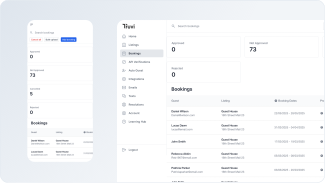
Truvi’s guest screening integrates directly with your booking flow, running automatic checks on every reservation without friction for legitimate guests.
This article is intended as guidance only. For the most up to date compliance regulations, follow official guidance from San Diego City. Note that if your property is in an unincorporated area of San Diego County rather than within City limits, different rules apply.