
TL;DR: Airbnb property managers typically charge 15–35% of booking revenue, depending on service level and location. Half-service (10–15%) covers listing, guest communication, and pricing, while full-service (20–35%) adds cleaning, inspections, and maintenance. Fees also vary by property type, condition, and amenities. To keep costs down, compare multiple quotes, negotiate on contract length, or consider a PMS or Airbnb co-host instead. Whatever you choose, make sure damage protection and liability cover are in place.
When you’re starting out on Airbnb, it’s easy to underestimate how much work is involved. If you’ve realized you don’t have the time to manage your property, but you still want to capitalize on your investment, hiring a property management company might be the answer.
But how much does that actually cost? And is it worth it?
In this guide, you’ll find out how much Airbnb property managers actually charge. We’ll break down the different fee structures, what’s included, and how fees are calculated. When you’re done reading, you’ll know what to expect, how to keep costs under control, and whether hiring a property manager is right for your vacation rental business.

How much do Airbnb property managers charge?
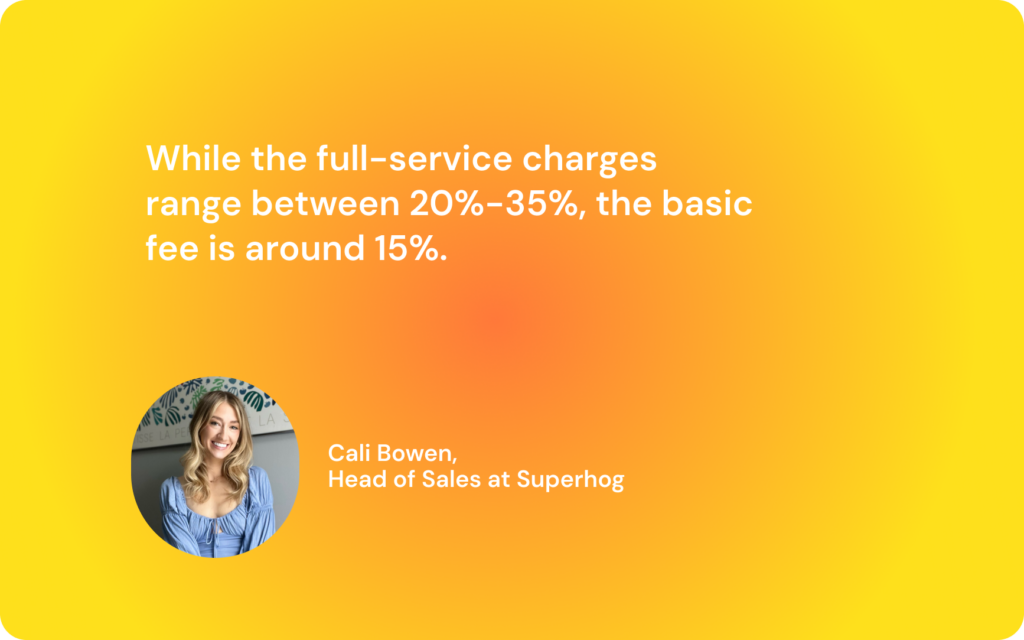
Property managers typically charge between 15% and 35% of your booking revenue. The exact percentage depends on the level of service and the company you choose.
Evolve, one of the more affordable options, charges 10–15% depending on your plan. That covers listing creation, marketing, and guest communication, but leaves cleaning and on-site support to you. Meanwhile, Vacasa charges closer to 25–35%, but that includes local housekeeping, 24/7 on-the-ground support, and maintenance.
To give you an idea: a property earning $3,000/month in booking revenue could see anything from $300 to over $1,000 in management fees each month. As you can see, the decision of hiring a manager is huge factor in how profitable short-term rentals are.
What are the different fee structures for property management?
Not all property managers charge a percentage of your booking revenue. Before you sign anything, it’s worth understanding the different pricing models and what they mean for your bottom line:
- Percentage of revenue: You pay a cut of whatever your property earns each month. This model incentivizes your manager to keep your occupancy rate high. However, you’ll need to be ready for cost spikes in peak seasons.
- Flat fee per booking: You pay a fixed fee on every booking, regardless of the booking value. It works well for higher-value properties where a percentage fee would be disproportionately large. Of course, there’s no incentive for your manager to push for more bookings or higher nightly rates.
- Monthly flat fee: You pay a fixed monthly fee, regardless of how many bookings you get. It’s easy to budget for, but you’ll paying full-price even in slow seasons. You’ll need to be confident that your peak season pays off every time.
- Hybid: You pay small base fee as well as a percentage of your booking revenue. The base fee covers your manager’s fixed costs, while the revenue share keeps them invested in your property’s performance. Be rigorous when you evaluate this model, as it’s easy for hidden charges to get buried in the structure.
| Fee structure | Typical cost | Pro | Con |
|---|---|---|---|
| Percentage of revenue | 15%-35% of booking revenue | Manager is incentivized to maximize your bookings | Costs can be unpredictable |
| Flat fee per booking | $50-$150 per booking | Costs won’t get out of hand on high value properties | Can add up quickly during high-occupancy periods |
| Monthly flat fee | $100–$500/month | Predictable monthly cost is easier to budget for | You pay the same even in slow months |
| Hybrid | Base fee + % of revenue | Balances predictability with performance incentive | More complex to evaluate the cost benefit |
Tip: If your manager uses a percentage model, make sure you know whether the percentage is taken before platform fees and cleaning are deducted or after.

What’s included in property management fees?
The biggest factor affecting how much you pay is how much you hand off. Most property management companies offer two tiers: half-service, which covers the essentials, and full-service, which takes care of everything. Consider how much involvement you really want, and make sure you understand what’s included.
“I constantly find myself taking care of random things, like scheduling to get things fixed, checking on details, coordinating with the handyman,” says one owner on r/AirBnB. “Where do you draw the line? I recognize that I have access to certain accounts for orders and need to approve things, but it’s just takes too much of my time each week.”
You’ll be able to avoid grey areas like this if you understand exactly what’s covered by your management fees. Here’s what each service type typically includes (and where the gaps are):
Half-service
Half-service usually costs around 10-15% of your booking revenue. It reduces the day-to-day load but doesn’t remove you from the picture entirely. You’ll still need to handle cleaning, property inspections, and anything that requires a physical presence.
What’s included in the half-service property management?
- Property listing and distribution across main platforms
- Guest communication and 24/7 availability
- Booking calendar management
- Basic guest screening
- Dynamic pricing strategy
- Coordinating maintenance requests
- Reporting to hosts
Who should choose half-service?
Half-service suits hosts who want to cut down on admin without fully stepping back. If you have one or two properties, live nearby, and enjoy having a hand in how your rental runs, this is a cost-effective way to get support where it counts most.

Full-service
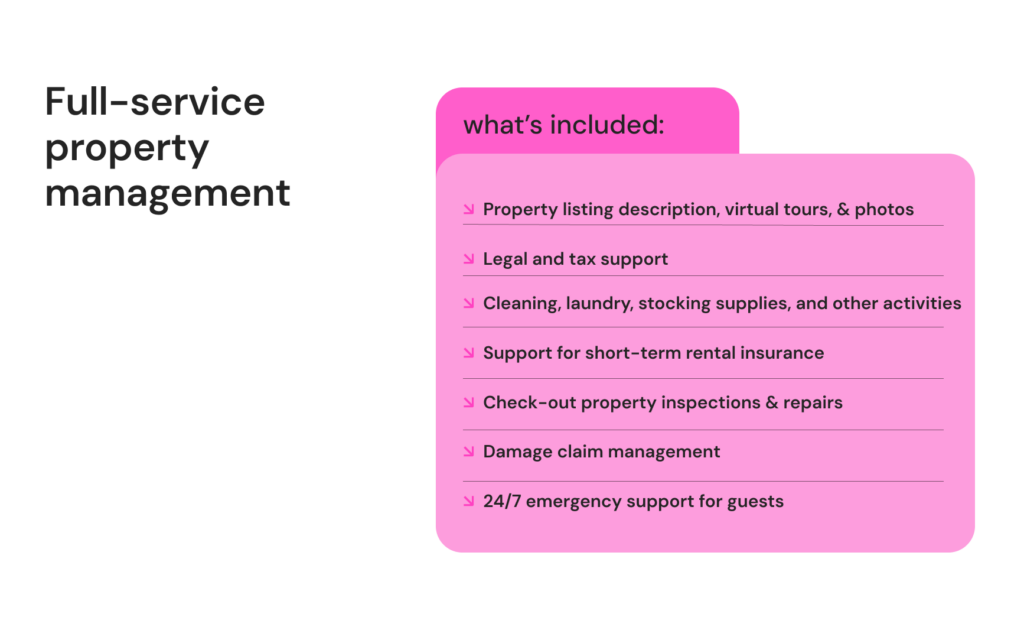
Full-service is as hands-off as it gets, but you pay for that convenience. Fees typically run 20–35%, and you’ll have less visibility and control over day-to-day decisions at your property.
What’s included in the full-service property management?
You’ll find it covers everything already included in half service, as well as:
- Professional photography and listing copywriting
- Cleaning, laundry, and restocking between stays
- Check-out property inspections
- Property repairs and vendor management
- Guest damage incident management
- Legal and tax support
- 24/7 emergency guest support
Some property managers also assist with furnishing, rental licenses, and short-term rental insurance. For some property owners, this offers total peace of mind that nothing will get missed. But you might prefer to have more control, especially in the early days of starting your short-term rental business.
Who should choose full-service?
Full-service is the right fit if you manage multiple properties, live far from your rental, or simply don’t want hosting to feel like a second job. The higher fee might feel worth it for the time saved and the consistency it brings to the guest experience.
What else affects property management fees?
If you think property management fees sound high, you wouldn’t be alone. A lot of hosts worry about hiring managers that charge a premium and don’t actually help your business thrive.
“I’m concerned with some of the reviews on management companies that I’ve read and their fees are extraordinarily high,” says one property owner on r/AirBnB. “I don’t think I can handle managing it myself as I have a full time job and [the property is] in another state.”
That said, what you actually pay can vary a lot depending on a few different factors. You might be able to lower costs depending on a few factors relating to your property. Take a look:
Location
Properties in high-demand tourist destinations typically attract higher fees. Not only are your nightly rates higher, but managers in competitive markets can charge a premium. Remote properties can also carry higher fees due to the travel time and logistics involved in managing them.
If you’re planning on operating in foreign markets, the cost of management will vary even further. United States is one of the most costly destinations, while Latin America tends to be cheaper. Here’s how property management fees may compare around the world:
| Location | Full service monthly charges | Half service monthly charges |
|---|---|---|
| United States | 20% – 35% | 10% – 15% |
| United Kingdom | 15% – 25% | 10% – 15% |
| European Union | 18% – 30% | 10% – 18% |
| Canada | 20% – 25% | 10% – 15% |
| Latin America | 15% – 20% | 8% – 15% |
| Asia | 15% – 25% | 10% – 15% |
For more inspiration on where to invest, check out our guide to the top 10 places to buy a vacation home around the world.
Property type
Larger properties with more bedrooms, outdoor spaces, pools, or hot tubs require more time and effort to manage. A four-bedroom house with a pool is simply more work than a one-bedroom apartment, and fees reflect that.
Condition of the property
Older properties or those in poor condition tend to generate more maintenance requests and carry a higher risk of guest damage. Some maintenance costs will be covered by Airbnb’s damage policy, but not all. You may find some managers want to charge more to take on old properties. Others won’t take them at all.
Amenities
The more your property offers, the more there is to maintain and restock. Properties with high-end amenities, smart home tech, or luxury finishes typically attract higher management fees.
Contract length
Committing to a longer contract often comes with a discounted rate. Just make sure you’re comfortable with any early termination clauses before signing.
Unfortunately, plenty of hosts had bad experiences with property management companies that don’t support their business at all. If you find yourself in a situation like that, the last thing you want is a contract that feels impossible to get out of.
Current performance
High-performing properties can sometimes negotiate lower percentage fees because managers are often willing to take a smaller cut when the volume makes it worthwhile. The reverse is also true: if your property has a low occupancy rate or generates modest revenue, expect to pay toward the higher end of the range.
Some companies won’t take on properties earning below a certain annual threshold, so it’s worth checking.
How is the cost of Airbnb management calculated?
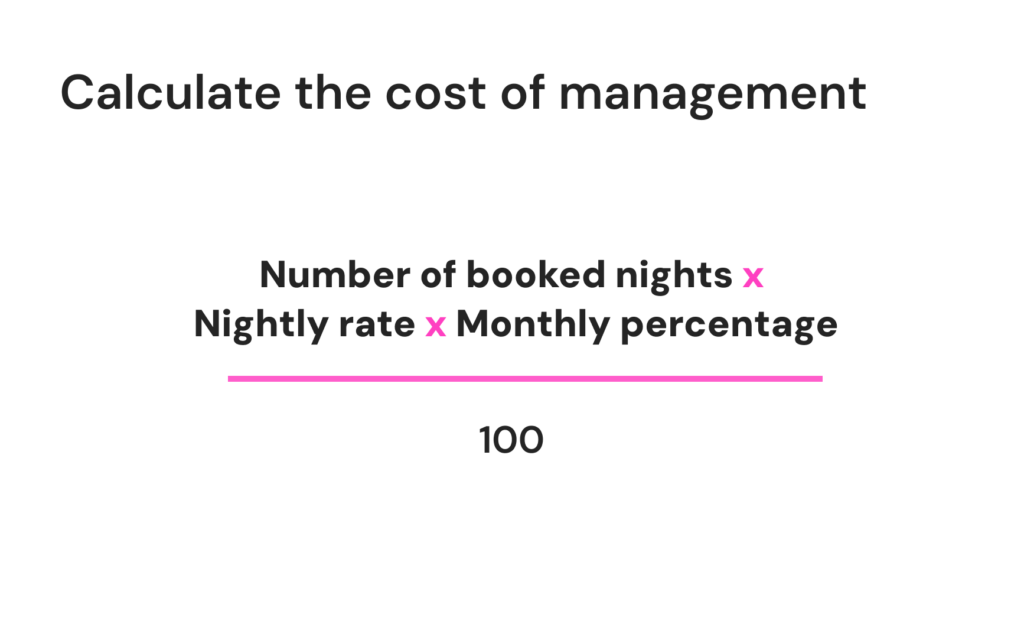
The cost of managing a short-term rental is typically calculated as a percentage of your gross booking revenue — that’s the total amount guests pay before platform fees or cleaning costs are deducted.
Knowing this, you can easily calculate the cost of Airbnbn management:
(Booked nights × nightly rate × management fee) ÷ 100 = monthly management fee
Let’s say your property is typically booked 15 nights per month. Your nightly rate is $200 and your management fee is 20% of your gross booking revenue.
That’s 15 x 200 x 20 ÷ 100 = $600/month in management fees.
What about net revenue?
Some managers calculate their fee based on net revenue, which means platform fees and other deductions come out first. This model could save you hundreds of dollars every month.
Let’s say your Airbnb management fee is 20% of net booking revenue. Everything else, like your nightly rate, stays the same.
First, you’ll calculate your monthly revenue: 15 × 200 = $3,000 gross revenue.
Then you’ll calculate your platform fees: 3,000 x 10 ÷ 100 = $300 Airbnb fees.
Now you know your net revenue: 3,000 – 300 = $2,700 net revenue.
Finally, the cost of management: 2,700 × 20 ÷ 100 = $540/month in management fees.
In one year, that’s $720 dollars saved on each property, compared to if your management fee was based on gross booking revenue.
How are Airbnb management fees charged?
Most full-service property managers collect booking payments on your behalf, so you don’t have to calculate costs yourself or manually pay any invoices. At the end of each month, you’ll receive your earnings minus property management fees and other costs like platform fees.
It’s a convenient setup, but it does mean you’re trusting someone else to handle your money accurately. Get into the habit of reviewing your monthly statements to make sure the numbers add up.
6 ways to cut the cost of Airbnb management
With a bit of research and the right approach, there’s often room to negotiate and reduce Airbnb management costs altogether. These are the strategies we recommend:
1. Negotiate
Research and compare at least three or four companies and get quotes from all of them. The more informed you are, the stronger your negotiation skills will be. Consider the following:
- Competition. With at least three quotes to compare, you might be able to ask your preferred company to match the price of another so they don’t lose out on competition.
- Longer contracts. If you can commit to 12-months or longer, this may unlock a better rate. Check real client testimonials to make sure you’re not getting tied into something that will harm your business.
- Multi-property deals. Managing several listings all at once reduces their overhead. Make sure they’ve factored this into their price and use it as leverage if not.
- Performance-based pricing. Some managers will accept a lower base fee in exchange for a bonus tied to occupancy or revenue targets. Just be sure you don’t over-commit to a bonus you’ll regret later.
2. Go for a smaller company or agent
Large companies juggle hundreds of properties, which can mean they pay less attention to yours. A smaller local company or independent manager might offer a more personalized service, and a more competitive rate to boot. That’s not to say all large companies will charge you a fortune, but it’s worth getting quotes from a range of organizations if you can.
3. Stay involved at first
You probably want to hire a management provider and forget about rental chores forever, but don’t rush. We’d recommend staying actively involved at first, to make sure your manager does their duties well.
You can:
- Ask guests directly. A quick message after checkout asking about their experience gives you an unfiltered view of how your property is being managed.
- Review your statements closely. Check that the fees being deducted match your agreement and that occupancy levels look realistic for your market.
- Inspect your property occasionally. Between guests, do random spot checks of your property and listings to make sure the cleanliness and presentation is up to standard.
When you’re confident your manager is delivering, you can step back — though you may still want to regularly review your statements to look out for anything unusual. You could also ask that your manager alerts you any time a significant repair cost comes up (e.g. over $250), so you’re aware of big revenue hits.
4. Get reliable damage and liability protection
Find out how your shortlisted property management providers handle issues like guest damage and liability claims. Some managers charge extra to handle damage on your behalf or require guests to pay a damage waiver. Worst case scenario, they pass repair costs directly back to you.
If you don’t have proper cover, a single incident can wipe out months of rental income. That’s why you need insurance or third-party damage protection services. Just be careful not to rely on standard landlord insurance, as these policies usually don’t pay out for vacation rental properties. The best insurance for Airbnb hosts is designed with short-term rentals in mind.
5. Use a property management system (PMS) instead
If you’re hands-on and want to keep more of your rental income, a PMS could mean you avoid paying management fees altogether. Tools lile Hostfully and Guesty automate the more time-consuming parts of hosting for a flat monthly software fee that’s a fraction of a management commission.
This works best for hosts who are local, manage a small number of properties, and are comfortable using software to run their business. Your PMS can handle direct bookings across multiple booking channels, and may even be able to integrate with other key tools like guest screening.
6. Use Airbnb’s co-host network
On Airbnb, you can skip hiring a property manager and share the workload with a local, vetted co-host instead. Depending on their experience, co-hosts can handle everything from guest messaging and pricing to cleaning and on-site support.
Airbnb co-hosts typically charge 15-25% of your booking revenue, but you only pay for the tasks you actually need help with. So it could end up cheaper than hiring a property manager. Airbnb also handles payouts, without taking a cut, splitting your earnings between you and your co-host automatically.
It’s a flexible, lower-commitment alternative to a full management company, but it only applies to the bookings you get through Airbnb. If you list on multiple channels, you won’t be able to use an Airbnb co-host for every booking.
The verdict: Should you hire an Airbnb property manager?
That depends on how much you want to be involved and how many properties you’re running. If you have one property, live nearby, and enjoy the process, you might prefer to get a PMS to help automate the repetitive tasks while you handle the fun parts of hosting.
If you’re managing multiple listings, live far from your rental, or simply want your time back, the right property manager can more than justify their fee.
Whatever you decide, don’t sign anything without getting at least three quotes, understanding exactly what the fee covers, and knowing whether it’s calculated on gross or net revenue. Those details could be the difference between a fee that works for your business and one that quietly eats into your profit.
No matter whether you choose to self-manage or outsource, consider guest screening and damage protection. With Truvi, every guest who books your property is automatically screened against our watchlist. You can add comprehensive ID verification, with damage protection included, to keep your investment safe from disrespectful or criminal guests.
Stop paying out of pocket for guest damage
Whatever your management fees, guest damage shouldn’t eat into what’s left of your profit. Truvi has you covered with up to $1M in damage protection — and direct payouts in 3–5 business days.