

Whether you are renting out a cozy lakeside cabin or a slick New York high-rise, sustainability is on everyone’s minds. How can you make your short-term rental more environmentally friendly? What’s the future of sustainable luxury tourism? Is it worth investing in sustainability in the first place?
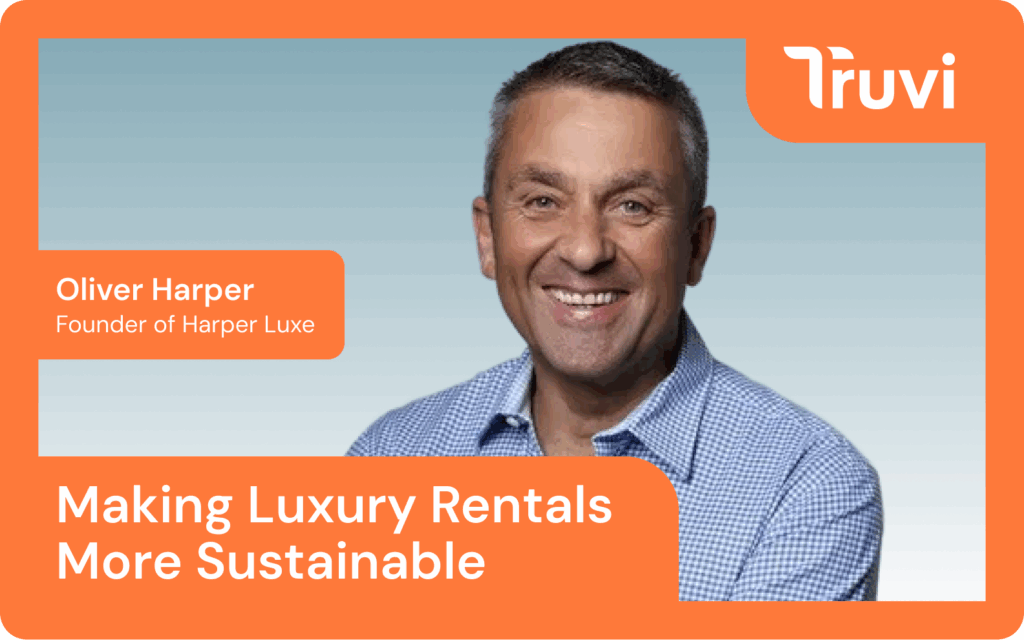
In this article, we speak to Oliver Harper, Founder of Harper Luxe and winner of a prestigious 2025 Greengage Solutions Sustainability Award, to answer all your questions about sustainability in the short-term rental industry.
‘Businesses must align with global climate goals’
“Short-term rentals have a unique opportunity and responsibility to reduce environmental impact, and we try to lead by example at Harper Luxe,” explains Oliver. “We’ve done that through energy efficiency, water conservation, and waste reduction.”
Harper Luxe guests can learn how to recycle within a given property in a simple app. They can even compost their food waste, “and eventually take it out into the courtyard and into our designated bin. There, they can put water on it, and eventually it will break down and we can use that.”
More sustainable short-term rentals aren’t just good for the environment, but for your bottom line too.
According to Oliver, sustainable stays are gaining traction as environmental awareness increases. “There are many eco-conscious travellers out there now who will pay more to have sustainable experiences.“ He assures us. “Sustainability in luxury isn’t a compromise, it’s an upgrade.”
And as a burgeoning niche, there is plenty of opportunity for creativity and expansion.
“Within Harper Luxe, we look at enhancing our brand recognition by aligning with global sustainability goals. We actually attended COP28 for the first time in Dubai, which really opened our eyes to how we can improve our offerings within our properties even further.
One of the initiatives that we do every year is that we plant a mango tree for every guest who stays in our apartments. From the research I’ve done in the UK, I know we’re the only company that does that.”
‘There’s a huge demand for historical regeneration’
“In Bedfordshire, where we’re based, we’ve won two awards for two town center regeneration projects, which has always been my passion as well as my team’s. We bought 2 sites which were completely dilapidated and on the verge of being knocked down, but we salvaged them, and we got a plaque in the town for it.”
Another project Oliver remembers fondly is the restoration of “the 12th Century Building, which was originally part of an Abbey where Henry VIII had his divorce papers carried out. We acquired the building and enhanced it to the point where we were actually approached by the local authority to sell it to them under the National Lottery for the English Heritage Tourist Information Building. So yeah, that was quite a fun one to work on.”
When it comes to projects focused solely on sustainability, Oliver is proud to announce that Harper Luxe has gone plastic-free. “So we’ve eliminated single plastics and we use all refillable amenities on top of that.”
‘Salvage materials and source locally’
“I’ve been in the industry now for over 45 years, so I’ve worked alongside some amazing people, and one of the things that’s always stuck out in my ethos and my teams’ is: renew and try to utilise what materials you have instead of buying brand new.” That is why Harper Luxe is big on salvaging materials.
“70% of all the furniture in our apartments is pre-loved. We also removed all the old chimney breasts that had old bricks and used those within the landscaping of the courtyard, as well as at the entrance. To that end, we also utilised granite kerb edging stones from when the High Street was being updated. I noticed that they were starting to throw them away and spoke to the contractors. Instead of throwing them in the skip, I said, ‘I’ll buy them’, and now we use those for flower beds in the courtyard, and we’ve used them for paving edgings around the back of the building as well.”
“Again, like I say, sustainable,” Oliver insists. As he points out, reusing and salvaging furniture and materials helps “offset carbon.” We have also introduced a complementary “Pashley” cycle hire service for our guests to offset their carbon footprint.
Plus, it looks great. “All the decor, the floorboards, we’ve utilised all these within the entrance passageway to give it that sort of old, wobbly charm,” which can be seen on the Harper Luxe website.
‘Sustainability will become a baseline expectation, not a bonus’
“With rising costs and regulatory challenges, there will be changes going forward.”
Take the Energy Performance “Grade C” Certificate as an example.
“All companies today and in the coming years will have to change and get a minimum of a C in their EPCs. Being in the industry, I could see what was happening, so we were ahead of the curve. A, B, and C are our benchmarks; anything over C. But unless you’ve got a specific grade now, trying to implement it at a later date is going to be very hard for so many companies.”
‘Ecotech will become standard in sustainable luxury short-term rentals’
“The tech side,” Oliver says. “We use smart systems now for the energy and water usage of guests. They actually have the ability to see it using an app, so they’re in control.” Oliver also mentions some of their more “experimental” sustainability work. “We engage with guests,” he explains. “We notify them about local nature, local culture, and the conservation efforts that we do.”
Finally, he adds “transparency, transparency, and certification. We try to show our guests what we do without bombarding them. With the eco-credentials we work with, like Greengage Solutions, there’s links on our website. So if they want to, they can go over and find out more information.”