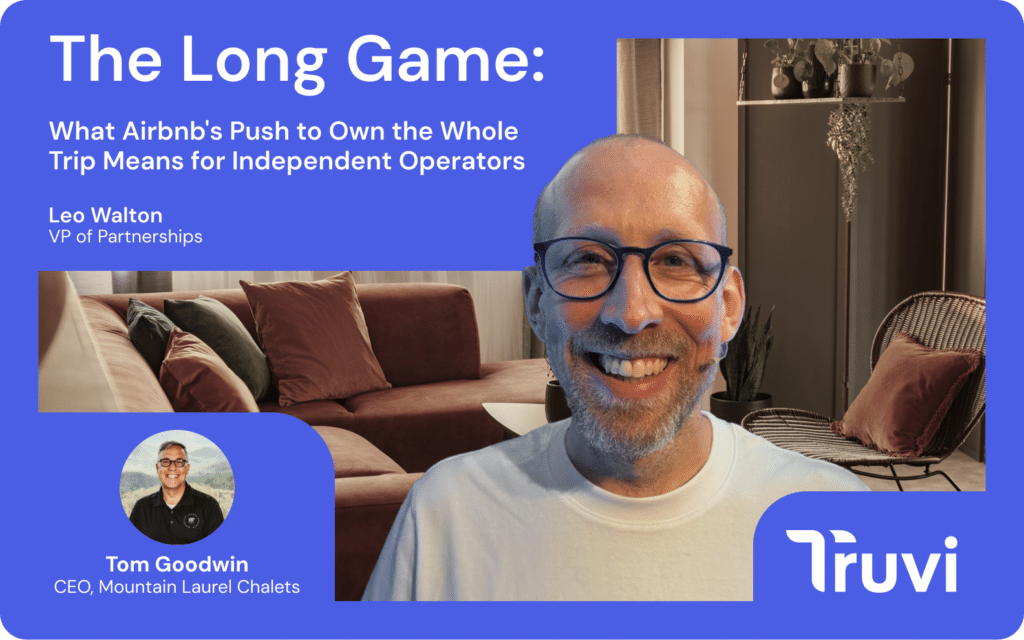

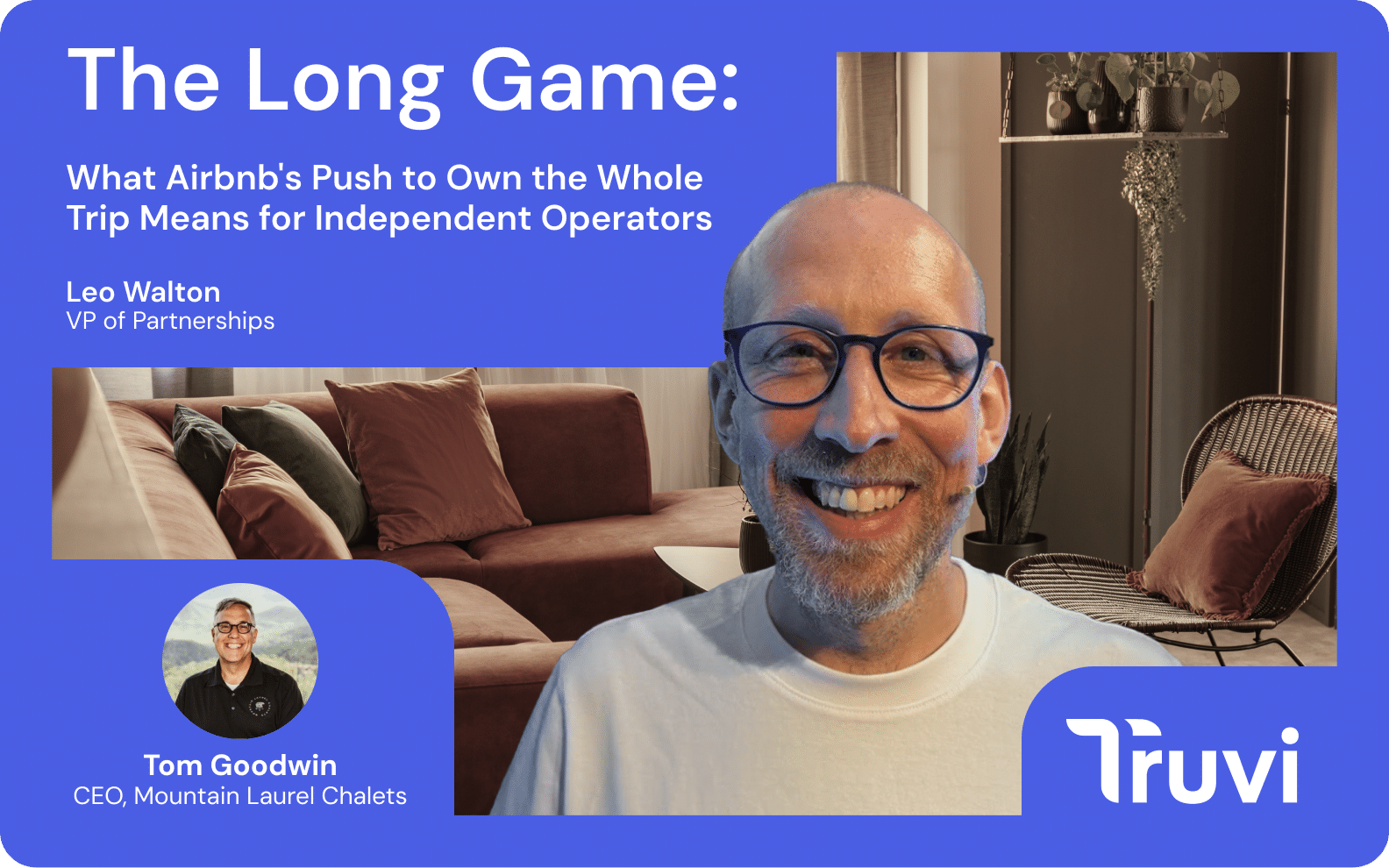
TL;DR: Airbnb’s biggest product push yet adds hotels, car rentals, grocery delivery, and airport pickups to the platform. For operators who depend on it for most of their bookings, that should prompt a harder question than it will for Tom Goodwin, CEO of Mountain Laurel Chalets in Gatlinburg, Tennessee, who has been running 75-80% direct for 54 years. His argument: use the platforms for what they’re good at, own your guest relationships directly, and you won’t need to be scared of where Airbnb goes next.
In 1972, Dot and Ralph Egli became the third vacation rental management company in Gatlinburg, Tennessee. Hotels in the area would call them when they were full, asking if they had room for an overflow couple. Dot and Ralph’s daughters would move out of their bedroom to make space. That was the beginning.
Their daughter Susan and her husband Tom Goodwin joined the business in 1992 and took it over in 2012. Mountain Laurel Chalets now manages over 95 properties in the gateway town to Great Smoky Mountains National Park, the most visited national park in the United States with around 12 million visitors a year. The business is in its 54th year, and it has been built almost entirely on repeat guests who come back because of the relationships, not because of the platform that sent them the first time.
That last part matters, because Tom, now CEO, is managing 75-80% direct bookings from a market that has grown from 350 vacation rentals in 1972 to around 25,000 today. He joined Airbnb two and a half years ago.
When my podcast co-host Sarah Nan DuPre and I spoke to Tom for The Check-In recently, Airbnb had just dropped its 2026 Summer Release: car rentals, grocery delivery, airport pickups, boutique hotels in 20 cities, and exclusive World Cup experiences, with flights reportedly on the way. Brian Chesky, Airbnb’s co-founder and CEO, is building toward an app that manages every part of the trip from landing to checkout.
“Travel shouldn’t just be convenient,” Chesky wrote in the release. “It should be meaningful. The best trips help you explore, learn, and come home a little different than when you left.”
It’s a strong line. It’s also close to what Tom has been building toward for 54 years. The difference is that Airbnb’s version of meaningful travel runs through Airbnb. Tom’s doesn’t have to.
Want to hear the full conversation?
This article is based on an episode of The Check-In podcast, where Leo Walton and Sarah Nan DuPre talk with the people shaping the short-term rental industry.
Listen on YouTube, Spotify, or Apple Podcasts.
The billboard
Mountain Laurel Chalets was a reluctant convert to Airbnb. The business had built its reputation over decades through Southern Living magazine, word of mouth, and a phone number guests had memorised. It worked. But first-time visitors to Gatlinburg were searching the platform and not finding them, and that was a problem worth solving.
“We were very reluctant to join in with Airbnb,” Tom told me, “but it became a little overwhelming for our market to attract the new first-time visitor.”
The decision to join came with a clear philosophy about what the platform was for. “We use it as a billboard effect. We clearly state who we are as much as we’re allowed to and use that as an opportunity to have an inbound guest for the first time and then to earn their business as repeat guests going forward.”
That distinction matters more now than it did two and a half years ago. Airbnb is no longer just a place to find accommodation. It is becoming the infrastructure for the entire trip. For operators who’ve handed it majority control of their bookings, that changes the nature of the dependency.
“If you remain in that 100% booking on OTAs, you have then acquired a majority partner that controls your business and you don’t have the ability to steer the direction that you need to go,” Tom said. “You become a servant to that entity.”
What the expansion means for operators who depend on it
Airbnb’s move into car rentals, airport pickups, and local experiences isn’t just about guest convenience. It absorbs revenue streams that operators have historically owned. A property manager who has built relationships with local transfer companies, experience providers, and restaurants, and who earns referral income from those partnerships, is now competing with Airbnb for the same guest attention at the same moment in the trip.
“If you are 100% dependent on the OTAs and Airbnb and they are now adding these things, you’ve got to begin thinking how do I create more of a direct booking engine and create those experiences that I can provide for the guests.”
Mountain Laurel Chalets’ version of local experiences isn’t a digital product. It’s relationships with restaurants, hiking guides, and businesses woven into the community over decades. “We love working and partnering with local operators, restaurants, people that would provide those type of experiences that the guests are looking for… And we add those on as a free referral… it comes back to us.”
That kind of embedded local knowledge is precisely what Airbnb is trying to package at scale with its new experiences and services. The operators who’ve built it authentically have a genuine advantage, but only if they own the guest relationship directly rather than depending on a platform to mediate it.
What platform pressure produces over time
There’s a version of hospitality that has quietly reorganised itself around review scores rather than around guests. Tom has watched it develop up close.
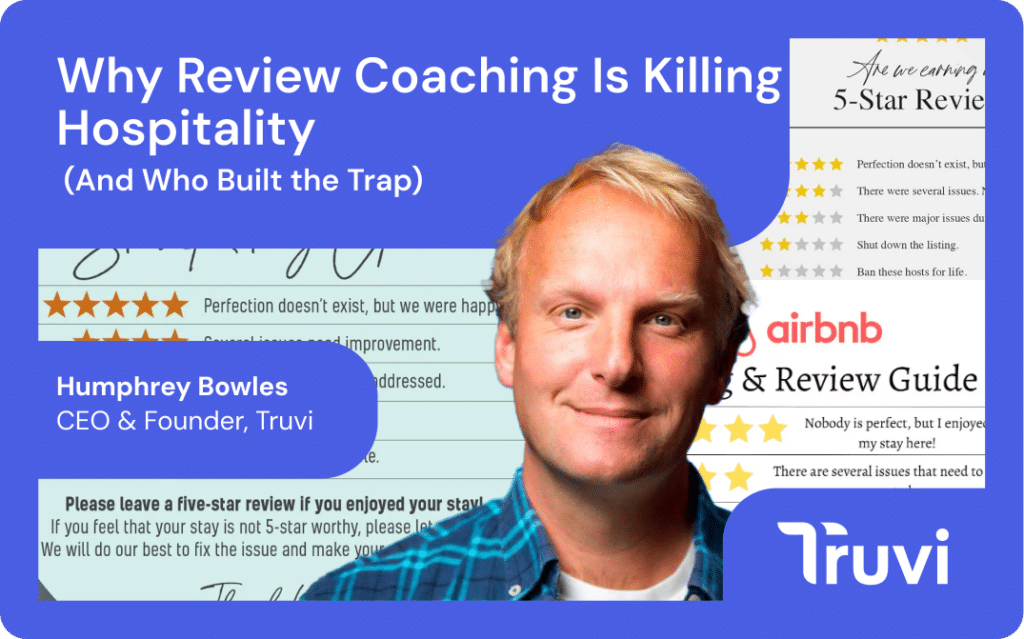
He visited a property recently as a potential new management client. Five bedrooms. Around three coffee cups in the kitchen. Surfaces worn through years of use without reinvestment. At the front door, a laminated sheet explaining how to leave a five-star review, noting that in return the guest would receive one.
“I took a photo of this PDF they had laminated at the door,” he said.
What the review system produces over time is a feedback loop that measures whether both parties were motivated to protect their platform standing, not whether anyone had a good time. Those things are related but they are not the same.
“You can play that game for the short run,” Tom observed, “but it’s not going to work over the long haul.”
The deeper issue is what platform dependency does to the product itself. Houses get consumed in ways hotel rooms don’t, and operators who are running hard on volume without investing back into their properties find out eventually.
“I always say to people when they rent a car, who cleans a rental car? No one cleans a rental car. They just hand it back and they don’t care about cleaning out the crumbs or anything like that. And that’s how all of our guests are consuming their homes.”
Rental car companies factor consumption into their model from the start. A lot of operators who scaled fast in 2021 didn’t. “Their homes are depleted. They haven’t invested back into them… the photos look great when you start, but how is the house doing and being maintained three or four years from now?”
The answer to that question, for Mountain Laurel Chalets, comes from having built a business where the product matters because the relationship matters. Which brings it back to the guests themselves.
Building memories
Tom described a guest called Rob Stone. He drives four hours from Kentucky to Gatlinburg three or four times a year with his eight-year-old son, Mason. Tom wrote about him recently on LinkedIn.
What Rob wrote wasn’t about amenities or the booking experience. It was about Mason running through Cades Cove. About what it means to keep returning somewhere that feels like it belongs to you, with people who are glad you came back.
“I had one vacation I remember as a child and I will never forget it,” Rob told Tom. “And what I am committed to is creating those memories for my son that will last throughout his life.”
Tom’s response to that isn’t a loyalty programme or a personalised itinerary generated by an app. It’s a business that has been showing up in the same place for 54 years, that knows the best hikes, the best parking spots, which season is worth the drive from Kentucky.
“He wants to be settled into an environment and a culture and with a vacation rental management company that is going to come alongside him and be a part of creating those deep, rich, lasting memories.”
Airbnb can introduce a guest to a destination. It can suggest experiences, arrange a car, stock the fridge before check-in. What it cannot do is be the business Rob calls when he wants to come back, the one whose name he already knows, the one that has been there since before he was born.
The long game
Tom isn’t arguing against Airbnb. He values what it does, uses it deliberately, and would like to see the platforms work alongside operators rather than in competition with them.
“I wish they would work more in partnership with us as opposed to seeing us as competitors,” he said. “I have a very strong bias towards abundance as opposed to scarcity.”
What 54 years in the same market teaches you is that there is enough to go around, but only if you have built something that doesn’t depend on any single source of demand to survive. The operators who have done that are watching Airbnb’s expansion with curiosity rather than anxiety. The ones who haven’t are discovering, with each new summer release, how much of their business they built on someone else’s terms.
Airbnb wants to build meaningful travel. Tom has been building exactly that. The difference is that his guests belong to him.
Know who’s staying in your property, on every channel
Truvi’s guest screening runs automatically on every booking, OTA or direct, so building direct guest relationships doesn’t mean taking on unknown risk.