

Airbnb does run background checks, but only for US-based users and India-based hosts, and only when it has a guest’s accurate legal name and date of birth on file. Everyone else gets identity verification of varying depth, plus an automated system that screens specifically for party risk rather than a guest’s wider history.
That’s a narrower answer than most hosts assume, and the gap between what Airbnb actually checks and what hosts think is being checked is where most of the risk sits, from vacation rental chargebacks to outright Airbnb scams. This piece breaks down what each of Airbnb’s three systems actually covers, where they fall short, and what hosts can do to close the rest of the gap themselves.
What does an Airbnb background check actually include?
Airbnb doesn’t run one background check. It runs three different processes, each with a different scope, and understanding which one applies to a given booking matters more than treating “Airbnb screens guests” as a single fact.
Identity verification
Every booking requires a full name, email address, confirmed phone number, and payment information at minimum. Beyond that baseline, Airbnb tiers up the verification depending on the guest’s country and whether its systems detect anomalies. In some cases, legal name and address are enough. Where that’s not sufficient, or isn’t available in a guest’s country, Airbnb asks for a photo of a government ID and a selfie to match against it. Identity verification specifically is required for guests travelling to 35 countries, and government ID isn’t always part of it even then. This tier applies inconsistently by design, triggered by risk signals and geography rather than applied uniformly to every guest.
Criminal conviction checks
This is the piece most hosts think of as “the background check,” and it’s the narrowest of the three. Airbnb works with an approved third-party vendor to check a user’s identifying information against publicly available court records and sex offender registries, but only for US-based users and India-based hosts. Everyone else, including guests booking from or into most of the rest of the world, doesn’t get this check at all. Where it does run, Airbnb reviews the vendor’s findings and may restrict, suspend, or remove an account depending on the severity of the offense and how recent it was. Less serious convictions may result in no action at all.
Reservation screening for disruptive gatherings
This is a separate system, and it’s easy to conflate with the criminal check above, but it does something entirely different. Identity verification and this reservation screening system are the two features Airbnb packages together under AirCover for Hosts, alongside its damage and liability protection. Reservation screening uses machine learning to look for signals associated with party risk: the guest’s account history, details of the reservation itself, the listing type, and even topics raised in message threads. If a booking scores as high-risk, Airbnb may block it outright, redirect the guest toward lower-risk listings, prompt them to acknowledge its policy against disruptive gatherings, or send it for manual review.
Coverage isn’t global yet. Airbnb states this feature is currently available in the US, Canada, and Australia, with a stated goal of expanding further where feasible. Airbnb has also run temporary, wider pushes around specific high-risk weekends, including Memorial Day, July 4th, and Halloween, in past years. Either way, this system exists to catch parties, not to vet whether a guest is trustworthy in general. A guest who has caused serious property damage in the past but has no criminal record and isn’t showing party signals will pass through it without friction.
Checks run on every booking, not just once
The criminal conviction check runs on every booking a guest makes, not only the first time they use Airbnb. That’s worth stating plainly because it’s easy to assume a screening result goes stale, but it doesn’t work that way here.
Limitations of Airbnb’s checks
Each of the three systems above has real value, but each also has a specific limit worth understanding before relying on it.
Coverage is geographically narrow
The criminal conviction check applies to US-based users and India-based hosts. Nothing else. A host in the UK, most of Europe, Australia, or almost anywhere outside those two countries is not getting a criminal history check on their guests from Airbnb, regardless of how the guest’s profile looks. Even within the US and India, Airbnb’s own documentation notes that local laws can limit which public records are available, and that criminal data is only updated periodically by local governments it doesn’t control. The check that does run isn’t guaranteed to be current.
The check follows the identity submitted, not everyone staying
Identity verification and the criminal conviction check are both built around the identifying information submitted for one user, the person who made the booking. Neither one independently verifies anyone else staying at the property. That’s different from AirCover’s damage protection and liability insurance, which aren’t gated by individual verification. Those cover incidents caused by guests during the stay generally, whether or not every person present went through a check. The gap is specifically in what Airbnb knows about who’s coming, not in what it’ll cover if something goes wrong once they’re there.
A verified identity isn’t proof the identity is genuine
Airbnb’s ID verification process confirms that a submitted photo ID matches a selfie and that the name on it matches the booking. What it doesn’t confirm is whether that ID belongs to the person using it in the first place. A stolen or borrowed identity that passes the liveness check will clear verification the same way a genuine one does.
Inna22, an Airbnb host, started requesting ID directly rather than relying on Airbnb’s process alone:
“I have started asking for IDs from all adults about a year ago and it has really improved the quality of guests. Airbnb does not verify anything… years ago a guy registered as ‘T-rex’ rented my house and trashed it. Because of that, I needed to take matters into my own hands.”
Hosts can’t act on what they find without a real cost
Even when a host does uncover something concerning after accepting a booking, whether through their own research or a guest’s behaviour in messages, cancelling isn’t free. Airbnb’s Host Cancellation Policy sets a $50 minimum fee, but the actual fee scales with the reservation: 50% of the value of the remaining nights if cancelled within 48 hours of check-in or after, 25% if cancelled 48 hours to 30 days out, and 10% beyond that. The listing’s calendar gets blocked for those dates regardless, and any payout already made is withheld.
There’s a waiver process for hosts who cancel because of a Major Disruptive Event or “certain valid reasons beyond the host’s control,” but discovering a red flag on a guest after accepting the booking isn’t listed as one of the qualifying reasons, and it isn’t listed as an excluded one either. Airbnb decides case by case, based on documentation the host provides. A host in this position genuinely doesn’t know in advance whether the fee will be waived. That uncertainty, on top of the fee itself, is a real disincentive to act on information that surfaces after a booking is already confirmed.
What hosts can do beyond Airbnb’s checks
Given how narrow Airbnb’s own coverage is, most experienced hosts build their own layer on top of it. None of the following takes much time, and together they close a meaningful part of the gap.
Request an ID photo directly
Airbnb collects a guest’s ID for its own verification but doesn’t share it with hosts automatically. Hosts can request a copy after booking, provided their listing discloses that requirement in advance, and most guests will send it without pushback.
If gathering this manually on every booking isn’t realistic at your volume, this is the kind of check that’s simple to automate instead of chasing it down one reservation at a time. Pippa & Benoit, a luxury property management business, connected Truvi’s Guest Verification so guests get sent an automatic verification link on every booking, replacing the manual ID chasing that used to eat into their day.
Check public information and social profiles
A reverse address or phone number lookup, or a quick search for the guest’s name on social platforms, takes ten to fifteen minutes and tells you whether the person behind the booking is who their profile suggests. This isn’t about being invasive. It’s checking information the guest has already made public.
Read reviews on both sides
A guest’s own reviews are useful, but a reviewless guest isn’t automatically a risk. Two hosts who’ve dealt with this directly put it well. Alina127 noted that her first bookings with no reviews turned out fine, since the guests were simply new to the platform. Sarah977 draws the same distinction: no reviews isn’t a red flag on its own, but a pattern of bad ones is. What’s worth reading in either case is what a guest has said about their own past hosts. A guest who leaves consistently harsh, unfair reviews of previous stays is telling you something about what to expect.
Ask a direct question after booking
A short message after a reservation is confirmed, asking what brings the guest to the property and what they’re planning, surfaces more than most hosts expect. Jett Kirk, a law-degreed Airbnb Superhost, has had guests answer this question badly enough to cancel outright: a group in their early twenties who admitted, unprompted, that they were planning a bachelor party at a property with a strict no-parties policy.
Treat local bookings and thin profiles with more scrutiny
A guest booking a property in the city they already live in is a pattern worth a second look, not an automatic decline, but worth asking about directly. It’s also consistent with what the data shows more broadly: Truvi’s own analysis of 90,000+ completed bookings found that guests booking within 20 miles of their home carry a meaningfully higher incident rate than guests travelling further.
The worst version of this scenario is a guest who won’t leave. If that happens, here’s what to do about Airbnb squatters.
Automate guest screening instead of doing it manually
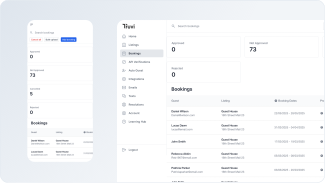
Everything above is worth doing, but doing it manually on every booking doesn’t scale past a handful of properties. Truvi’s guest screening runs automatically on every booking rather than only on the subset Airbnb’s own checks happen to cover: watchlist checks against guests with a history of unpaid damage, email and phone verification to catch disposable or fraudulent contact details, and instant results in your booking report as Approved, Flagged, or Rejected. It runs before a booking is treated as settled, not after, and it applies the same way across every channel, OTA and direct alike, rather than depending on which country a guest happens to be booking from.
For properties or portfolios that want to go further, Truvi also offers ID verification, criminal background checks against 2,400+ US databases, and sex offender registry checks against the US National Sex Offender Registry as add-ons, alongside damage protection covering up to $1M per incident if something still goes wrong.
Screen every guest, not just the ones Airbnb happens to cover
Truvi runs automatic guest screening on every booking, regardless of which country your guest is booking from, so protection doesn’t depend on Airbnb’s geographic limits.