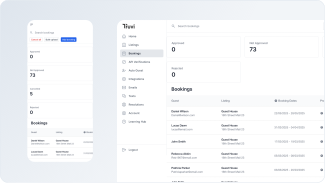

Truvi provides guest screening and damage protection for short-term rental hosts, and is registered with the UK’s Information Commissioner’s Office. If you’ve been asked to complete a Truvi verification, pay a deposit, or pay a damage waiver, this is a standard part of how some hosts manage bookings. We only collect what’s needed to verify your identity and process payment securely, and never sell guest data. Deposits and waivers are used by a smaller number of hosts who set them up before Truvi moved to its current model; most hosts today use protection that doesn’t involve any guest payment at all. To confirm a request came from us, you can contact Truvi directly.
If you’ve been sent a request to complete a guest verification, deposit, or damage waiver through Truvi, it’s reasonable to want to know exactly what this is and who you’re dealing with before you hand over any information or payment. Here’s what Truvi is, what that request means, and how to confirm you’re dealing with us.
What is Truvi?
Truvi is a guest screening and damage protection platform used by short-term rental hosts and property managers, across Airbnb, Vrbo, direct booking sites, and other channels. Hosts use us to verify who’s booking their property and to protect against damage during a stay.
If you’ve been asked to pay a deposit or waiver
Some hosts fund their damage protection through a deposit or waiver paid by the guest at booking. If that’s what you’ve been sent, it’s a legitimate, active part of how Truvi works with certain hosts.
A damage deposit is refundable. It’s held against possible damage during your stay and returned to you after checkout if there’s nothing to claim against it.
A damage waiver is a one-off, non-refundable payment. Instead of a refundable hold, it covers you for accidental damage during your stay up to the terms your host has set, so you’re not liable for repair costs yourself if something goes wrong.
Either way, payment is processed securely through Truvi, not paid directly to your host.
Why we ask for the information we do
Truvi only asks for what’s needed to verify your identity and, where applicable, process a deposit or waiver: your name, contact details, and in some cases a form of ID. We don’t collect information beyond what that verification requires, and we don’t sell guest data to third parties.
If a request seems to be asking for more than that, or for information unrelated to identity or payment, that’s worth querying directly with your host or with us before you continue.
Why this might come up after you’ve already booked
Guest verification is usually a step in the booking process your host has already set up, not something added on afterwards. Verification and damage protection tools like Truvi are a standard part of how many professionally managed short-term rentals operate, whether the property is listed on a major platform or booked directly. If you weren’t expecting it, that’s more often a sign of a well-run listing than a red flag, but you’re always entitled to ask your host directly if anything feels unclear.
Confirming a request is from Truvi
Truvi has worked with short-term rental hosts since 2019. We’re insurance-backed but are not ourselves an insurer. We’re registered with the Information Commissioner’s Office (ICO) under registration number ZA518818, and we meet GDPR requirements for how we collect and process guest data.
If you want to double-check a request you’ve received, you can contact Truvi directly rather than relying solely on a link sent by your host.
How Truvi protects your data
We review our data handling against current industry standards on an ongoing basis and never sell guest information to a third party. Our data protection policy covers encryption and handling, third-party audits, access controls, and continuous checks in more detail.
Why hosts work with Truvi
Standard home insurance rarely covers what happens during a short-term stay booked through a platform, and OTA damage policies come with tight limits and slow dispute processes. Truvi closes that gap with automatic guest screening on every booking and damage protection that pays out directly, without hosts having to chase guests themselves.
For some, it’s the confidence of knowing who’s actually booking. “As a cybersecurity professional who’s overcautious, I was happy to see a company like Truvi exists. It’s like a firewall,” says Eddie Challita, an independent operator.
For others, it’s what screening makes possible. “Truvi services allow us to fend off the bad actors, especially in the markets with high rates of malicious actors. Now we can drive more direct bookings without worries,” says Nicole Pace, COO of Sojourn.
And when something does go wrong, hosts value getting paid without the fight. “Since we implemented our partnership, Truvi has also gotten us back money that guests and AirCover were unwilling to pay. Truvi provides peace of mind and sleep,” says Ben Earley, CEO of HOLT.
Truvi’s protection products for property managers
Truvi’s current protection is paid per booking, with no guest deposit or waiver required. This is how every new host is set up. Deposits and waivers were part of an earlier product structure, still supported for the hosts who set them up at the time, but not something new hosts are offered.