
TL;DR: Airbnb’s built-in damage protection (AirCover) covers up to $3M in damages, but comes with strict rules — you must document damage thoroughly, contact your guest within 24 hours, and file a claim within 14 days of checkout. Claims can take weeks and are frequently denied for missing documentation. To better protect yourself, combine AirCover with proactive measures like guest screening, detailed property inspections, and third-party damage protection services.
It’s every property manager’s worst nightmare: guests trash your property, leaving you with a huge bill to repair the damage.
This is exactly what happened to John Hildebrand of Hilde Homes, who’ll you’ll hear from in this article. After an otherwise uneventful booking at his Arizona vacation rental, he opened the door to find overflowing bins, a dog mess, missing appliances, and badly stained bedsheets.
This time, John didn’t wait for Airbnb to fix the situation. He claimed his money back in three days, thanks to Truvi’s damage protection. But what if he did need to make a claim through Airbnb’s damage policy, AirCover? This article explains what AirCover includes and exactly how to make a claim. You’ll find out how Airbnb’s damage policy works and what steps you can take to protect your property before ever needing to make a claim.
How does Airbnb’s damage policy work?
When you list on Airbnb, you’ll be automatically covered by Airbnb’s damage protection program, AirCover, which includes Host Damage Protection. Host Damage Protection is free of charge, available for all hosts, and you don’t need to sign up for it separately.
AirCover damage protection includes:
- Up to $3 million damage protection, with special cover for art and valuables, auto and boat, damage caused by pets, loss of income, and deep cleaning.
- $1 million liability insurance to cover guest injury, damage, or theft of guest property.
- 24-hour safety line to provide support to hosts and guests.
Find out what’s covered below, or read the Airbnb damage protection terms for more detailed information.
What damages does Airbnb cover?
Airbnb’s damage policy covers losses that directly result from the actions of a guest or their visitors. If you encounter losses that have nothing to do with your guests, it’s not covered.
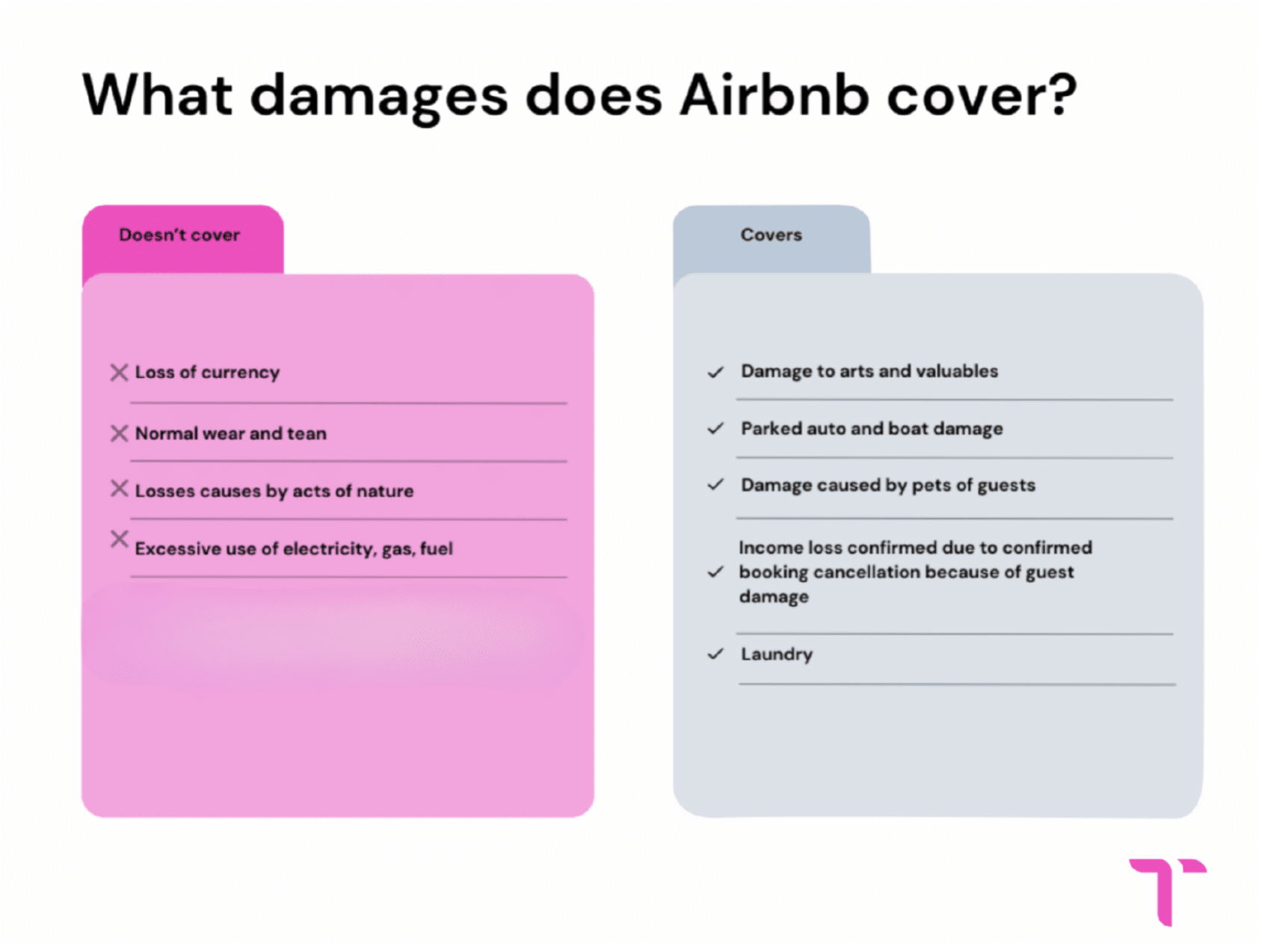
Airbnb’s damage policy covers:
- Damage to art and valuables
- Parked auto and boat damage
- Damage caused by pets of guests
- Income loss due to confirmed booking cancellation because of guest damage
Doesn’t cover:
- Loss of currency
- Normal wear and tear
- Losses caused by acts of nature (e.g, hurricanes)
- Excessive use of electricity, gas, fuel, water or other utilities
Airbnb isn’t the only place where you can list your vacation rental. Here are 15 Airbnb alternatives, dig in!
What happens if your guest damages your Airbnb?
When damage happens, you need to act fast and document everything. Arizona property manager — and 2026 Truvisionaries top-voice — John Hildebrand discovered severe damage after what seemed like a normal booking. When his housekeeping team entered the property, they found guests had sneaked dogs in without paying the pet fee.
There was dog mess everywhere, overflowing trash cans, badly stained towels and bedsheets, and missing appliances like hairdryers. “There was dirt everywhere,” says John. “Every single pair of sheets was destroyed, all the towels were damaged — it was very disrespectful.”
As a host, you’re going to face all kinds of damage to your property, from general wear and tear to the kind of scenes John describes. Tanya Simmonds, Truvi’s Senior Resolution Advisor, shares the most common types of damage in our guide: Guest Damages in Vacations Rentals.
If you ever find yourself in a similar situation with your Airbnb, here’s what to do:
Step 1: Document the damage thoroughly
Take timestamped photos and videos of everything as soon as you or your cleaning team enters the property. The more evidence, the better. If your housekeepers were first on the scene, get a written statement from them — their testimony can strengthen your case if Airbnb needs additional proof.
Step 2: Reach out to the guest directly
Contact the guest through Airbnb’s messaging system to let them know about the damage. It’s important to keep communications within Airbnb, in case you need evidence of this conversation later. Keep things factual and professional. Let them know that you’ll request compensation for the damages.
Step 3: Submit a claim through Airbnb’s Resolution Center
Head to Airbnb’s Resolution Center and select “Request compensation for damages.” Fill out all the details and attach your evidence. You have 14 days from the day your guest checked out to report the incident, so don’t wait.
Step 4: Follow up with Airbnb support if needed
Once you’ve submitted your request, the guest has 24 hours to respond. If you don’t hear back or they decline to pay, you can submit a reimbursement request under Airbnb Host Damage Protection. Then, Airbnb Support will step in to review your request. If you do find yourself in this situation, be sure to escalate to Airbnb Support within 30 days of the damage occurring — missing this window could mean losing your claim entirely.
What can you do if your claim is denied?
Even if you follow Airbnb’s rules, there are loopholes that may lead to your claim getting denied. For example, claims commonly get rejected if you file after the 14-day window, fail to show a clear before and after trail, or skip the guest contact step. Here’s what you can do:
- Appeal the decision. You can appeal once, so check the reason for denial carefully. Address it directly by presenting any relevant information or documentation you can.
- Contact Airbnb Support. Automated denials are frustrating, so get in touch with Airbnb Support to speak to a person. Reference your claim number when you open a live chat with an agent. They might be able to give you clarification on a denial reason or push your appeal forward.
- Fall back on alternative protection. After a certain point, you may need to give up on AirCover and fall back on other means. That’s why it’s important to have comprehensive insurance or damage protection services through a third-party like Truvi.
“The biggest benefit [of having third-party protection] is not having to chase after payments,” says Saskia van der Bolt, CEO at Villa in Umbria. “It takes away the bureaucratic hassle, saves time and it calms down hosts who worry about damage to their properties.”
How do you make a claim for an Airbnb damage deposit?
In the past, you could collect a security deposit when taking bookings on Airbnb. You had two options: either the platform would put an authorization hold on the guest’s payment method, or you could use Airbnb’s offline fees feature to collect the deposit directly. However, Airbnb security deposits have now been retired in favor of AirCover.
Most hosts aren’t allowed to collect deposits for Airbnb bookings, unless you’re a software-connected host with unique or high-value amenities at your property. In this case, you may be able to collect a deposit using a third-party property management system (PMS). To submit a claim, you’ll need to go via your PMS. You can’t do this directly in the Airbnb platform.
How do you handle Airbnb guest damages if you don’t have a security deposit?
If you discover guest-related damages and you have no deposit to rely on, be sure to document the issue immediately. Be as thorough as possible, getting timestamped photos and videos as well as any receipts that detail repair or cleaning costs. You’ll have 14 days from the date of checkout to request reimbursement directly from your guest via Airbnb’s Resolution Center. You’ll find a step-by-step guide above, in the section: ‘What happens if your guest damages your Airbnb?’
What if an Airbnb guest refuses to pay for damages?
After you file a request following the rules of the Airbnb damage policy, the guest has 24 hours to respond. If they ignore the request, decline the payment, or pay only partially, you can file a reimbursement request under Host Damage Protection, a part of AirCover for Hosts.
Airbnb Support will review the request to decide whether you are eligible for reimbursement. If you are, it usually takes around two weeks to get the payment. Still, you may not receive the requested amount if Airbnb Support considers your documentation incomplete or suspicious.
Steve Aspesi, a former Superhost, recalls a time when “guests got drunk and a little out of control” on Quora. Steve says the guest did fess up and paid for repairs. However: “Had the guests not agreed to make things right, Airbnb said they would have covered the damage that went beyond the deposit.”
8 ways to prevent damages before you need AirCover
You can’t always rely on guests (or Airbnb) to keep your property safe. But there are ways to prevent damage in vacation rentals. For example, Daniel Tocora, founder of AZ Getaway, recommends doing guest screening before anyone can book your stay. Here’s more information on how to protection your property and avoid the Airbnb claims process:
1. Implement guest screening and ID verification
Guest screening is your first line of defense, catching fake profiles, suspicious patterns, and known troublemakers before they ever set foot in your property. Airbnb has a built-in ID verification process that checks basic information like names, addresses, and government IDs. While this catches some fraudulent bookings, it has serious limitations. Platform screening is basic at best, and it only works for bookings made through that specific platform.
You can get tools that go much deeper, and check all bookings regardless of which platform they’re made on. For example, Truvi’s guest screening services automatically checks every booking against multiple databases and an internal watchlist of known problem guests.
“The added security is a big selling point for homeowners,” says Saskia van der Bolt, property manager and CEO. “New hosts often worry that guests will ruin their homes. Although these fears are often unfounded, having the extra security can help to persuade homeowners to work with me.”
Guest screening catches fake names, disposable emails, and burner phones — all the red flags that platform verification misses. A good screening platform will ensure the screening process happens instantly, too, so your guest won’t get slowed down when making a booking.
2. Spot troublesome guests in advance
Whether or not you have guest screening in place, it’s helpful to know how to spot red flag behaviors and vacation rental scams. Look out for:
- Bad guest reviews: This is the most reliable indicator that guests may cause trouble, so check reviews. Hosting guests with no previous reviews can also be risky, so be sure to reach out via the platform chat to get a sense of who your guest is.
- Bending the rules: Guests who try to dispute your house rules or convince you to make an exception (for example, to allow pets if you have a policy against it) may be problematic in the long run.
- Payment difficulties: When guests don’t pay on time, their cards get declined, or they want to pay through alternative methods, this could mean trouble.
- Odd-looking email addresses: A strange email address with random numbers could be created for the purpose of creating a new Airbnb account, therefore might be suspicious.
- Difficulty communicating: Not all guests want a hands-on host, but if yours are difficult to get hold of or won’t answer direct questions, this could be a bad sign. Look out for irrelevant responses or particularly poor grammar, but be mindful that your guest might be communicating in their second language.
- Live locally: If your guest’s home address is nearby, this should raise your suspicions. They might be looking to rent a property to throw a party.

3. Make your house rules impossible to miss
Vague rules are easy to ignore. Spell out exactly what’s allowed and what isn’t — maximum occupancy, no smoking, no pets, no parties — and include the consequences for breaking them. The more specific you are, the harder it is for guests to claim they didn’t know.
Don’t just bury your rules in the listing description. Display them in a printed welcome guide, a digital guidebook, or a prominent spot in the property itself. The more touchpoints guests have with your rules, the less room there is for misunderstanding.
4. Follow a detailed inspection process
Before-and-after evidence is your strongest asset if you ever need to report an incident. Before every stay, photograph and video every room, appliance and piece of furniture. Keep a detailed inventory of every item in your property, and update it regularly. If anything goes missing or gets damaged, you’ll have an accurate record to reference. Also, make sure your housekeepers know to take photos and videos of damage immediately. They’re often the first to arrive after a guest, so should be able to spot issues right away.
5. Consider smart monitoring devices
You can get noise monitors to alert you to unusually loud activity without invading your guest’s privacy. Smart locks give you a record of when the property was accessed and by whom. This tools provide helpful evidence should you ever need to submit a claim, but they also act as passive deterrents, since guests feel more accountable for their behavior.
6. Get short-term rental insurance and protection
As a short-term rental host, it’s your responsibility to protect your property — even when guests misbehave, break things, or leave damage. While platforms like Airbnb offer basic coverage, relying solely on platform protection leaves serious gaps.
You have two main approaches for protecting your properties:
- Traditional insurance providers like Proper Insurance, Safely, and Pikl offer comprehensive policies designed for vacation rentals. These work like standard insurance — you pay premiums upfront and file claims after damage occurs. They’re best for hosts who want broad coverage including liability, natural disasters, and structural damage. The tradeoff is longer claims processing times (often weeks or months) and higher costs.
- Damage protection services like Truvi take a different approach. Instead of covering costs after problems happen, Truvi prevents issues upfront through guest screening, then handles damage incidents quickly when they do occur. Our damage protection covers up to $1M with decisions typically within 5 business days — not weeks or months.
Many property managers use a combination of damage protection for day-to-day risks, plus traditional insurance for major structural issues or liability coverage. Some choose damage deposits or damage waivers, which work by charging guests additional fees when they book. As you can imagine, this adds some guest friction, but there are pros and cons to both approaches, as we’ll get into below.
7. Consider a vacation rental damage deposit
Some hosts charge a refundable security deposit when a guest places a booking. If guests leave the property in good condition, you return the full deposit. If there’s damage, you deduct repair costs before refunding the remainder. Vacation rental damage deposits typically range from $250-$500 for standard properties, up to $2,000+ for luxury rentals. You can also calculate deposits as a percentage of booking totals (usually 10-12%).
Most platforms support deposits, though the process varies. Airbnb places authorization holds on guest payment methods, Vrbo lets you collect refundable deposits or have guests purchase protection, and Booking.com requires direct arrangements with guests. Many property managers now combine deposits with screening and damage protection services for comprehensive coverage across all booking channels.
When using deposits, communicate the amount clearly in your terms and conditions, document property condition with timestamped photos before and after each stay, and return deposits quickly when there’s no damage. Understanding local regulations governing deposit amounts and refund timeframes is also essential.
8. Request a vacation rental damage waiver
Every time a guest stays, your property will go through a little wear and tear. Small scratches on your table, a stained towel, or a chipped plate — they aren’t worth the admin of claiming from a deposit. But, when they happen over and over, they start draining your profits.
“Around 10% of our bookings cause some form of damage, of which, 90% can be covered by a damage waiver,” says Nick Taylor, Managing Director of Nox. A damage waiver is an optional, non-refundable charge included in the total rent price of your property.
Airbnb doesn’t support vacation rental damage waivers directly, but you can offer it as an add-on. Not all guests will want to pay for a waiver, but some will. It gives them peace of mind that they won’t be charged for any accidents that happen during their stay. For many hosts, selling damage waivers is attractive because you can save up the earnings from multiple waivers for bigger, more costly emergencies.
Protect your Airbnb properties faster than the platform can
Airbnb’s damage protection exists, but it comes with serious limitations. The documentation requirements are extensive, the process takes weeks or months, and you’re left waiting while repair costs pile up. When you’re managing properties professionally, you can’t afford that kind of delay.
You’re also only covered on bookings taken through the Airbnb platform. That’s why many property managers choose other ways to protect their businesses, such as third-party damage protection services through a platform like Truvi. No matter which channels you use, Truvi’s damage protection is automatically applied to bookings that use our guest screening service. You’ll typically get a decision within five business days, and payment will be made directly to you — no need for any awkward confrontations with your guests.
Ready to stop chasing guests for damage payments?
Get up to $1M in protection with 5-business-day turnaround. No months-long waits, no extensive back-and-forth with platforms.