
TL;DR: Airbnb has largely phased out security deposits, steering hosts toward its own AirCover damage protection instead, though software-connected hosts using a third-party PMS can still collect deposits. Deposits offer peace of mind but create guest friction and extra admin. For most hosts, a combination of AirCover, third-party damage protection, and short-term rental insurance offers stronger, more reliable coverage. Whatever route you choose, clear communication with guests about your damage policy is essential.
If you’ve never checked out a guest, opened the front door, and felt your stomach drop – count yourself lucky because it’s not uncommon. In fact, 44% of hosts list guest damage as a top-three worry when it comes to their properties, and 41% flag normal wear and tear as a close second.*
So, is an Airbnb security deposit the answer?
The same report found that most hosts rely on third-party protection or the basic cover provided by their booking platform rather than security deposits. That could be because deposits almost always cause guest friction. Also, Airbnb now actively discourages hosts to take deposits.
This guide will explain how Airbnb security deposits once worked, and how some hosts may still be able to request them. You’ll also find out how much to charge, how to communicate with guests about your damage policy, and – more importantly – how to set yourself up so you’re protected before anything goes wrong.
What is an Airbnb security deposit and can hosts still use them?
There was a time when you could set a refundable security deposit when creating a listing on Airbnb. When guests booked, Airbnb would either collect the deposit up front or place a hold on their payment method.
If a guest caused damage during their stay, you could submit a claim to receive funds from the deposit to cover repair costs. Otherwise, the guest would get their deposit refunded in full.
Here’s how the two options once worked:
- Airbnb-required security deposits: Airbnb would place an authorization hold on a guest’s payment method. The guest would be informed that they may be charged additionally if they cause damage to the property. This method of collecting a deposit is no longer an option.
- Host-required security deposits: Hosts would use the Airbnb “offline fees” feature to set a security deposit. Guests could see the specific sum and conditions during the booking process. This option is still available to some hosts.
Airbnb now actively discourages hosts from taking a security deposit. Instead, the platform expects you to rely on AirCover, Airbnb’s damage protection scheme that can reimburse hosts up to $3 million in the event of guest damage. The problem with that is many hosts find it hard to get legitimate claims approved by Airbnb under AirCover, as you’ll see below.
Can hosts collect security deposits outside of Airbnb?
Airbnb actively discourages hosts from collecting deposits, on or off the platform. The only way to collect a security deposit outside of Airbnb is as a “software-connected” host.
Software-connected hosts use a third-party property management system (PMS) to handle guest communication and bookings. If your property has particularly high-value amenities, you may be permitted to collect an “offline deposit” via your PMS. However, you must be transparent about this in the “Fees” field on your listing, so guests aren’t caught by surprise. You can see more on how this works below.
Otherwise, you’re not permitted to request deposits at all. For example, you can’t text a guest separately through an app like WhatsApp and ask them to send a deposit via PayPal or Venmo. You could get reported to Airbnb and have your listings, or even your entire account, removed.

How much should I charge for a security deposit?
How much you charge depends on the value of your property and amenities. It’s entirely up to you what amount to ask, although very high deposits will be a barrier to many guests.
When setting your deposit amount, you may want to consider:
- The value of your property and the items within it
- Any recent renovations or expensive updates
- The likelihood of damage (e.g. does your property attract guests with kids and pets, or large groups, or mainly solo travelers?)
- Your location and local rules (for example, Denver Airbnb rules differ from in other US cities)
- Your overall rate and how the deposit amount compares to it
- How often you have had trouble with damage before (if it happens frequently, you may want to charge a higher deposit)
- Your typical guest (for example, people on business trips are more likely to accept a deposit than student backpackers)
Security deposit amounts tend to hover between $250 to S$500 USD. They can be as much as $1,000 to $2,000 depending on the property, location, and value of contents. The general industry recommendation is that the deposit should not exceed 20% of the cost of the booking.
How should I inform my guests about the Airbnb security deposit?
“With guests, be as kind as possible from the very first contact to when they leave. Even if things go wrong, if you have the right attitude, they’ll come back,” says Saskia van der Bolt, Truvi customer and property manager. With that in mind, the best way to communicate about your damage deposit is to be transparent and make sure guests know what to expect.
Follow these best practices to reduce conflict around deposits:
- Include your deposit in the ‘Fees’ section on Airbnb. That way, guests know exactly what they’ll pay before they even book.
- Mention your damage policy on the listing. In a friendly-but-firm way, mention your security deposit fees in the House Rules on your listing. This gives you an opportunity to appeal to guest’s better nature and communicate why a deposit is needed.
- Be transparent about the process. On your listing, clearly explain how much they’ll pay, how it will be collected, and what sort of damage is covered. Note that the deposit is refundable, so they’ll get their money back in full if they respect your property and rules. The more they understand, the more likely they’ll be to pay.
- Repeat your rules and policies. Once your guest books, send them your house rules and damage policy via email. You can also include a hard copy at your property in your guest manual. If you cover all bases, your guest won’t be able to claim ignorance of your rules.
- Act swiftly and keep receipts. Check the property for damage as soon as the guest checks out. If you notice something amiss, take plenty of timestamped photos and get in touch with your guest right away. Keep receipts when you pay for repairs or additional cleaning. That way, your guest is less likely to argue the amount or claim the damage was caused by someone else.

Pros and cons of charging an Airbnb security deposit
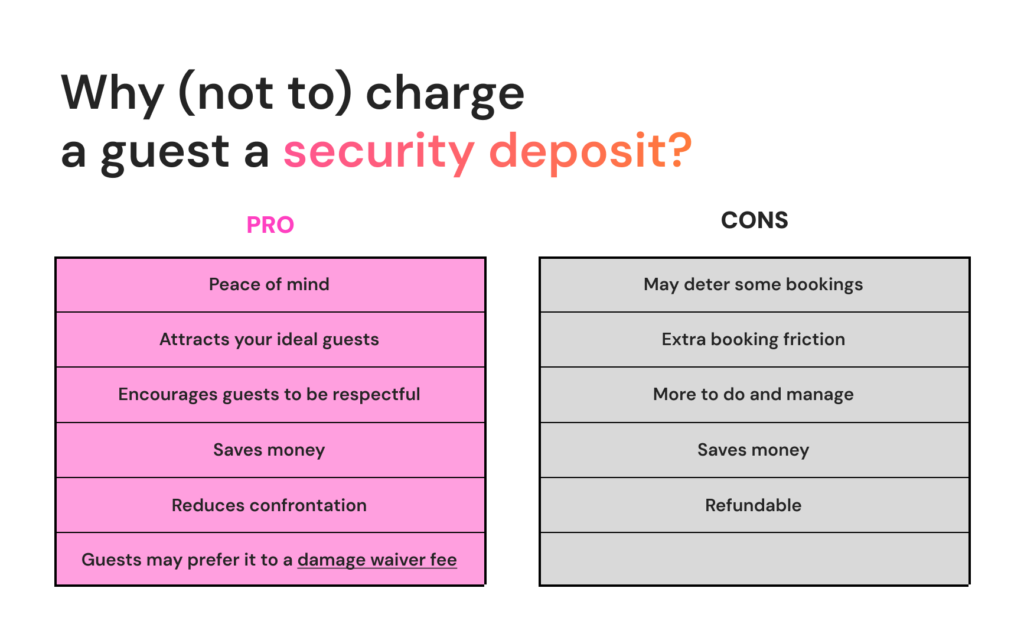
Even if you’re a software-connected host, charging an Airbnb damage deposit isn’t mandatory. It can give you peace of mind that you won’t be out of pocket, but there are also downsides. Check out the pros and cons below before you make a decision.
Pros of charging a security deposit
- Peace of mind. Like an insurance policy, a security deposit is there in case you need it (even though you hope you don’t). It’s an extra layer of protection for your property and business, which can significantly reduce the stress of opening your door to unknown guests.
- Attracts your ideal guests. Guests who intend on behaving badly are less likely to book your property. Of course, no-one likes paying extra, but you might be able to reassure well-meaning guests by communicating your deposit policy in a clear, professional way up front.
- Encourages guests to be respectful. Guests who know that there are consequences for damage will be more careful in your property, even if they have kids and dogs, or smoke. This will help to prevent parties, encourage rule-abiding, and reduce the risk of damage overall.
- Saves money. The main reason for charging a guest a security deposit is saving money in the event of damage. It could save you stumping up for expensive repair costs and protect your income. You’ll have ready money to make repairs quickly, minimizing the risk that you’ll need to cancel future bookings.
- Reduces confrontation. Clearly communicating a deposit policy in your House Rules makes it easier for you to charge guests if damage is done, with minimal confrontation or arguing. You can refer them to the policy, ask them to agree upfront, and they can’t claim they didn’t see it.
- Guests may prefer it to a damage waiver fee. Guests will get a deposit back if there’s no damage. They may prefer this to a waiver, which is non-refundable even if there is no damage.
Cons of charging a security deposit
- May deter some bookings. Some may think the cost is too high, or be frustrated by the request in the first place. Even good-intentioned guests might overlook your property in favour of one that doesn’t require a deposit.
- Added guest friction. Explaining the rules and adding an extra payment step adds friction to the booking, which might put guests off. Not only that, but you may have to have a difficult conversation with a guest when damage occurs. Withholding a deposit can cause a confrontation, even if your guest knew what to expect up front.
- More to do and manage. In the short-term, it’s obviously easier not to have a policy in place, as it’s more to set up, manage, and enforce. In the long-term, however, this small extra effort may be worth it if it saves you stress and thousands in damage.
- Refundable. The amount is only taken if damage is done (and proven), so it does not count towards your income unless you incur costs. It’s different to a security waiver, which is non-refundable and collected whether there’s damage or not.
Now Airbnb doesn’t allow deposits, how can hosts get damage cover?
Since Airbnb security deposits aren’t an option for most hosts, you need to know how to protect your property from damage. These are your options:
Option 1: Submit a claim through AirCover
When you get bookings via Airbnb, you’re automatically enrolled on AirCover, which includes host damage protection (formerly Host Guarantee) and ID verification (yes, Airbnb does do background checks on guests, but they’re basic).
AirCover for hosts covers damage caused by guests, their pets, invitees to the property, furnishings, vehicles, and boats. It also covers extra cleaning costs due to damage, stains or smoke; and income lost if you need to cancel other guests due to previous guest damage.
It doesn’t cover damage due to normal wear and tear, natural disasters, or normal cleaning costs. Nor does it cover loss of cash, or guest injury (though this is covered separately by Airbnb’s Host Liability insurance).
As soon as you notice damage, you’ll need to document it thoroughly. Then, you have 14 days to request reimbursement through the resolution center on Airbnb. According to Airbnb’s damage policy, you must give your guest 24hrs to respond before you escalate your claim. If your guest doesn’t respond, refuses to pay, or pays only partially, Airbnb Support will review your claim and you could get up to $3 million in damages covered.
But many hosts find it almost impossible to claim through AirCover, experiencing delays and denied claims. “If you have a legit claim and strong evidence like I do here, don’t count on Airbnb to take your side and pay,” says a Reddit user after “a lot of back and forth” with Airbnb Support over an incident.
Another commenter agrees, noting that AirCover promises a lot but doesn’t deliver. “You absolutely need third-party coverage if you want to ensure you’re actually covered,” they add.
Option 2: Charge a deposit through your PMS
As a software-connected host, you may be allowed to use your PMS to collect a security deposit outside of Airbnb. The deposit itself will be handled via your PMS, however you need to declare the fee on your Airbnb listing for transparency.
Here’s how it works:
- Your listing must be connected to a channel manager or PMS on Airbnb’s official API partner list
- You can check the status of the connection under Listings > Listing editor > Edit preferences > Property management software
- In your PMS, you can configure a security deposit under “offline fees”
- When you set the amount, consider the value of your property and furnishings. Deposits typically range between $100-500, but could be over $1,000 for high-value homes
- Choose which channels the deposit applies to, e.g. Airbnb, Vrbo, direct bookings, etc.
- Specify how payment is taken, e.g. via card authorization or a charge on Stripe, for example.
If damage occurs, you’ll be able to withhold or charge the pre-authorized funds, depending on how payments are handled in your PMS. If your guest leaves your property just as they found it, their deposit is automatically refunded.
Option 3: Use third-party damage protection
A lot of hosts turn to damage protection through third-party services. This is usually a more reliable alternative to AirCover – with faster payouts and no guest friction caused by requesting or withholding a deposit. Plus, you’ll be covered no matter which platform your guests use to book, so you can rest assured that direct bookings are covered just the same as Airbnb bookings.
For example, with Truvi, you get up to $1 million of damage protection per incident included with guest screening, so you know exactly who’s staying at your property and can avoid problem guests before damage occurs. When something goes wrong, you can easily report the incident through your dashboard and our resolutions team handles the rest.
Option 4: Rely on insurance
Deposits tend to be capped at a certain value and AirCover doesn’t cover ordinary wear and tear or damage caused by natural disasters. That’s why a lot of hosts also have insurance. However, standard homeowners and landlord policies often exclude coverage for paid guests, leaving you exposed. If you’re choosing an insurance policy, be sure to find one that offers dedicated cover for short-term rentals.
The downside of relying on insurance is that complex claims require a lot of paperwork and it could take weeks before you see a payout. Not ideal if you need to repair and re-let your property fast. It’s best to think of STR insurance as essential long-term protection, not a quick fix for day-to-day guest damage.
Beyond Airbnb security deposits
Damage to your property is an inevitable part of hosting, even if the majority of your guests have the best intentions. If you’re a software-connected host on Airbnb, you may still be able to collect deposits using the “offline fees” feature on Airbnb. This gives you extra protection beyond what AirCover can offer.
However, deposits always cause friction – whether it’s giving you extra admin or exposing you to conflict when charging a guest for damage. We’d always recommend looking into alternative cover, particularly if you take direct bookings or manage listings across multiple booking platforms.
Ideally, you’d have third-party protection that goes beyond platform cover and applies to all your bookings, no matter what channel they came through. It’s worth looking into damage protection services like Truvi if you want thorough guest screening, faster payouts, and less dependency on Airbnb’s good will.
Protect your properties with zero deposit friction
Get comprehensive damage protection up to $1M and screen every guest automatically. No deposits required, no holds on guest cards, no Resolution Center disputes.
*State of the Short-Term Rental Industry Report (2024), Rent Responsibly.