
TL;DR: When you take direct bookings, you take on the risks that OTAs would otherwise absorb — no host damage protection, no platform-backed fraud prevention, no built-in dispute process. The good news is that third-party tools have matured to the point where you can build better protection than any platform provides. This guide covers what good direct booking protection looks like, what to look for in a provider, and the additional measures — guest screening, rental agreements, and damage documentation — that reduce risk before it becomes a claim.
When you take direct bookings, you take on the risks that OTAs would otherwise absorb. No host damage protection. No platform-backed fraud prevention. No centralised dispute process. What you gain in margin and control, you lose in safety net — unless you build one yourself.
That’s what this guide is about. Not whether to get insurance for direct bookings, but what good protection actually looks like, what to look for in a provider, and what else you can do to make direct bookings as secure as a platform booking — or more so.
What to expect when choosing direct bookings over OTAs
Direct bookings give you more control over your business — but they also transfer more responsibility onto you. The margin advantage is significant: without OTA commissions of 15-20% per booking, you have more room to offer competitive pricing while still earning more per stay. Plus 70% of guests prefer booking through an OTA if the price is identical.
But getting those bookings requires its own strategy — if you’re just starting out, our guide on how to get direct bookings is a good place to start.
Here’s what the shift to direct bookings actually means in practice:
- No third-party rental platforms taking a cut of every booking
- Full control over your pricing, cancellation policies, and guest communication
- No OTA commissions or service fees
- More administrative responsibility — booking management, payments, fraud prevention
- Stronger customer relationships and full ownership of your guest data
- More marketing effort required, at least initially
- Lower visibility in the short term while you build your direct audience
- No built-in host damage protection if something goes wrong
Direct bookings have considerable advantages — more freedom, a higher return on investment, and the ability to build a brand that guests remember and return to. These advantages are strong enough to outweigh the challenges, provided you have the right protection in place. Third-party damage protection can more than compensate for the absence of OTA coverage. Considering expansion? Read our 10 tips on managing direct booking listings remotely.


Why direct bookings need specialised protection
OTAs are expensive and restrictive — but they do provide a baseline of protection. Airbnb’s host guarantee, platform-backed fraud prevention, centralised communication records, and built-in dispute resolution all come as part of the package. When you go direct, that baseline disappears. Here’s what you’re taking on.
Weaker guest screening
On a platform, guests have verified profiles, review histories, and platform accountability. On your direct booking website, anyone can submit a booking with minimal friction. Without a screening process in place, you have very little visibility into who’s actually arriving at your property. That’s why you need a specialised protection plan that covers different types of damage and a robust guest screening tool to go with it.
Less official communication
OTAs keep all communication and payments within their platform, which creates a clear record if anything goes wrong. With direct bookings, guests might reach you through your website, email, Instagram, or WhatsApp. That fragmentation makes it harder to maintain organised records — and harder to protect yourself in a dispute. Keeping communication centralised, whether through your PMS or a dedicated inbox, is essential.
Higher risk of cancellations and refunds
Platform cancellation policies create a layer of accountability that disappears with direct bookings. Without it, you need clear, visible policies of your own — communicated at the point of booking and built into your rental agreement. The good news is that you no longer need deposits or waivers to keep guests accountable for damage. Dedicated damage protection services like Truvi apply coverage automatically on every booking, with no guest-facing charges required — meaning you’re protected without adding friction to the booking process.
No protection against property damage
Without OTA host protection, any damage a guest causes is your problem to resolve. Third-party damage protection fills this gap — and done well, it can offer broader, faster coverage than platform programmes. Truvi covers accidental and intentional damage up to $1M depending on your plan, and also includes advanced guest screening to further protect your investments against the risk of problem guests. No platform claims process, no weeks of waiting.
Is using homeowners’ insurance an option?
Standard homeowners insurance is designed for owner-occupied homes — and most providers will tell you as much in their terms. If you’re hosting paying guests, you’re operating outside the scope of what these policies are built to cover.
The gap matters. Homeowners insurance typically protects against fire, flooding, lightning, and other force majeure events. What it doesn’t cover is the specific risk profile of short-term rentals: accidental guest damage, malicious damage, unauthorised parties, excessive cleaning costs. These are exactly the incidents you’re most likely to face as a host, and exactly what standard homeowners policies exclude.
That said, homeowners insurance isn’t worthless — it can complement dedicated STR protection by covering structural and force majeure risks that fall outside the scope of guest damage protection. The two work better together than either does alone.
The bottom line: homeowners insurance alone isn’t sufficient for direct bookings. Vacation rental insurance is worth it — designed specifically for short-term rentals, it covers the incidents that matter most and applies regardless of which channel the booking came through.
Insurance for direct booking essentials

Not all vacation rental protection is equal. Check out some options of the best insurance for short-term rentals to compare providers — but as a baseline, here’s what good coverage looks like.
Sufficient coverage
It’s easy to assume you’ll never need significant coverage — until you do. A single serious incident can run to tens of thousands in repairs, and some cities also have regulatory requirements around minimum liability coverage that you’ll need to meet before you can legally operate. Check your local regulations before choosing a plan, and err on the side of more coverage rather than less. The cost difference between tiers is usually modest compared to the risk of being underprotected.
Accidental and malicious damage
Homeowners insurance covers disasters. What you actually need as a short-term rental host is coverage for the incidents that happen regularly — spilled wine on a sofa, a broken chair, smoke damage in a non-smoking property. Minor incidents become significant when they repeat across dozens of bookings a year. Good direct booking protection covers both accidental and intentional guest damage. It can also be combined with homeowners insurance to cover force majeure events that fall outside its scope.
Quick resolution process
Claims speed matters more than it might seem. A slow process means repair costs coming out of your pocket while you wait, potential vacancy periods, and the stress of chasing a claims process you can’t control. Look for a provider that resolves claims in days rather than weeks, with a straightforward evidence submission process — not one that requires extensive documentation before anything moves.
Liability and loss of income coverage are worth considering as additional layers. Liability protection covers you if a guest is injured on your property and holds you responsible. Loss of income coverage provides financial support if serious damage puts your property out of action for an extended period, covering the revenue you lose while repairs are carried out.
Additional ways to protect your short-term rental
Damage protection covers you when things go wrong. But the best strategy is making sure fewer things go wrong in the first place. Here are the additional measures worth having in place alongside your core protection.
Implement guest screening
When you move away from OTAs, you lose access to guest review histories and platform verification. Guest screening fills that gap — running automatic checks against watchlists of known problem guests, verifying contact details, and flagging suspicious bookings before they become your problem. Verified guests are also less likely to cause damage when they know checks have been run. Truvi’s guest screening runs automatically on every booking with no guest friction required.
Sign a short-term rental agreement
Ask every guest to sign a short-term rental agreement digitally before arrival. This should cover check-in and check-out times, maximum occupancy, house rules, prohibited behaviours, and liability for damage or rule-breaking. It sets clear expectations and gives you a paper trail if anything goes wrong. Tools like SignWell and HelloSign make the signing and document management process straightforward. Find more details on what to include in a short-term rental agreement.
Collect a security deposit or damage waiver
Deposits and damage waivers give guests a financial stake in how they treat your property. A deposit is refundable provided no damage occurs; a waiver is a smaller non-refundable fee that covers minor accidental damage. If you’re using dedicated damage protection like Truvi, neither is strictly necessary — coverage applies automatically with no guest-facing charges. But for hosts who want an additional layer of accountability, particularly for higher-value properties or higher-risk bookings, they remain a valid option alongside your core protection.
Ask cleaners to check and report damage
Your cleaning team are often the first people into the property after a guest checks out. Make it standard practice for them to photograph any damage immediately — before anything is cleaned or moved. That documentation is your strongest evidence if you need to submit a claim, and catching issues quickly means faster repairs and fewer gaps between bookings.
How much does insurance for direct bookings cost?
Costs vary depending on the level of coverage you need, the type and value of your property, your location, and how frequently you rent. There’s no single figure that applies across the board — but understanding what drives the cost helps you choose the right plan.
The main variables are coverage tier and frequency of use. More comprehensive coverage costs more per booking, but the gap between tiers is usually modest relative to the protection it buys. For hosts who rent occasionally, a per-booking model means you only pay when you have guests. For those running a full rental business, comprehensive year-round protection is the more reliable and often more cost-effective choice.
The best approach is to contact a few providers, compare what each tier actually covers, and work out which package fits your portfolio. Truvi’s damage protection is priced per booking with no annual premiums — you can view current pricing to get a clear picture of what coverage at each level costs.
Truvi’s combo as an alternative solution for direct bookings
When you go direct, you need screening and damage protection that works across every booking regardless of channel — not platform-dependent coverage that disappears the moment a guest books outside Airbnb.
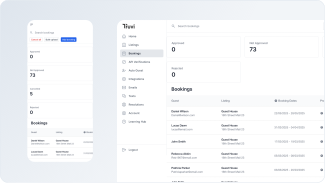
Truvi’s guest screening runs automatically on every booking, checking guests against a watchlist of known problem guests and verifying contact details in real time. You get an instant result — Approved, Flagged, or Rejected — with clear reasoning, so you can make informed decisions without slowing down the booking process.
Damage protection works alongside screening on every booking, covering accidental and intentional damage, excessive cleaning costs, smoke damage, unauthorised parties, and more — up to $1M depending on your plan. There’s no charge to guests, no deposits or waivers required, and when damage occurs, Truvi handles the claims process directly, paying you within 3-5 business days of settlement.
Together, they give you the protection infrastructure that OTAs provide — without the commissions, the restrictions, or the platform dependency.
Protect your direct bookings with Truvi
Guest screening and damage protection built for hosts who’ve gone direct. Automatic checks on every booking, up to $1M in coverage, and no guest-facing fees or deposits required.




![Lodgify Reviews: Is Lodgify Right for Your STR Business? [2026]](https://truvi.com/wp-content/uploads/2025/06/Bookster-Review-1024x639.png)