
First time on Airbnb? Or, maybe, you have never thought about how they check guests, and now it bothers you.
It begs the question: How does Airbnb verify identity?
Even though most guests are the sweetest people who won’t cause any harm to your property, once in a while, someone can make their stay a disaster.
The web is full of stories from hosts who have let strangers live in their rental property and had their properties destroyed.
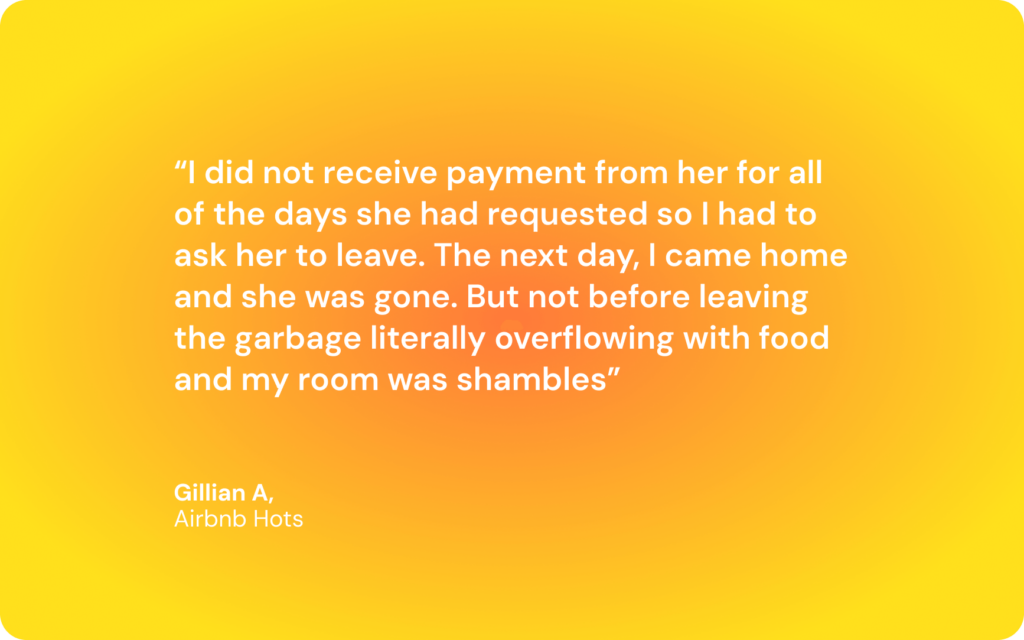
Gillian A is one of those who has shared her sad experience with hosting through Airbnb:
“I did not receive payment from her for all of the days she had requested so I had to ask her to leave. It was incredibly uncomfortable. The next day, I came home and she was gone. But not before leaving the garbage literally overflowing with food so that it was spilling everywhere. My room was a shambles, the towels left on the bathroom floor and she left a fair amount of food in my fridge (which I was clear about in the “rules” section – please take any food you bring in with you.)”
How do you prevent cases when hosts ruin your property and you cannot hold them accountable?
Learn what Airbnb ID verification can and cannot do for you.
Even though the Airbnb verification process is in place and covers all guests, it has its limitations. So here’s more about the limitations, how long ID verification takes on Airbnb, and other Airbnb guest verification nuances.
How does Airbnb verify ID?
Even though Airbnb identity verification has been used for over a decade, in 2023, the platform made it mandatory for all users booking reservations. It’s good news for hosts who can now receive more details about potential guests.
Hosts, co-hosts, and guests must verify their identity for all bookings.
During the Airbnb verification process, users must confirm their personal information, including legal name, phone number, address, and contact details.
Sometimes, the platform runs Airbnb guest ID verification based on the information you provide during sign-up, but you may also need to provide additional information.
Here is what Airbnb asks for:
- Legal name, address, and/or additional personal information. Personal information may be enough for identity verification, but it depends on your location or any anomalies the platform detects.
- Government ID photo. If Airbnb needs additional verification, they may ask you to take a picture of your government ID (e.g., passport, national identity card, or driving license).
- Selfie. On top of the government ID photo, you may need to add a selfie as an extra step for Airbnb ID verification.
In the US, users can also verify their identity through facial recognition. However, this option is not available in most locations.
So, as you can see, Airbnb ID verification considerably varies based on the user’s location and who the platform considers reliable or suspicious.
Also, learn more about the Airbnb guest screening process and the Airbnb host guarantee.
Does Airbnb do background checks?
Airbnb does check some background information on guests, but this check is not as deep as a host would want.
There are too many gaps in Airbnb guest verification due to outdated or limited databases.
Here’s what the platform says about their background checks in the official policy:
“If we have at least a first name, last name, and date of birth for a US-based user who creates a listing, or is associated with a booking, we may perform a background check on that user. We also may perform background checks on India-based Hosts.”
Airbnb submits the identifying information of selected users to one of its providers to check their identity against public records. But they don’t check every user.
You can find more details on Airbnb background checks in our recent blog post.
What guest information is shared with Airbnb hosts?
The details you learn about potential guests before accepting their booking is what can help you decide whether you want to see them in your property. Would you let in someone with a recent criminal record? Probably not. But that’s not what you will know about rental applicants on Airbnb.
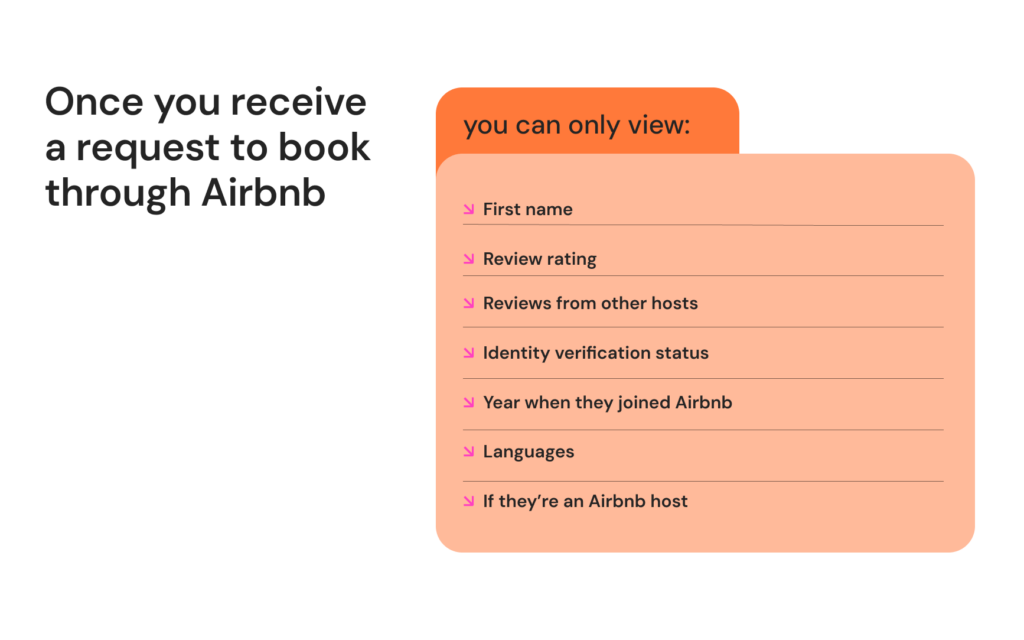
Once you receive a request to book through Airbnb, you can only view:
- First name
- Review rating
- Reviews from other hosts
- Identity verification status
- Year when they joined Airbnb
- Languages
- If they’re an Airbnb host
After accepting the booking, you will see the guest’s first name, last name, and profile photo. Airbnb allows hosts to ask for ID after confirmation, but you must indicate it as required information in the listing description.
Is this enough to decide whether someone is a good match and feel sure they won’t damage your property? You decide. We believe it’s not, and that’s why Truvi designed a platform that provides extra features for short-term rental risk management.
How long does Airbnb ID verification take?
Now, let’s discuss one of the most popular questions about the Airbnb verification procedure: How long does it take for Airbnb to verify ID?
For guests, Airbnb ID verification time is usually less than 1 hour. The duration depends on the location and may take up to 24 hours in the worst cases. How long does Airbnb take to verify ID, also depends on the accuracy of shared information. If a guest provides outdated or inaccurate details, it will take more than an hour, for sure.
Airbnb encourages guests to complete verification when they make a booking as soon as possible and sets a specific deadline. If the check-in starts within 12 hours, guests will have 1 hour to verify their identity. For other reservations, guests have 12 hours to complete verification after booking.
For hosts, verification deadlines are not that pressing. You don’t need to worry about how long it takes for Airbnb to verify your ID. You’ll be asked to go through identity verification when creating a listing or if someone invites you to join as a new Co-Host. There is no time limit, but Airbnb won’t publish your listing and allow you to accept bookings until you finish.
What does “awaiting guest ID” mean on Airbnb?
“Airbnb awaiting guest ID” is a reservation status that informs hosts and guests about the booking progress and what needs to be done.
The host requires the guest to complete identity verification before confirming their booking request. Overall, guests have 12 hours to verify their identity.
What are the limitations of Airbnb ID verification and background checks?
Airbnb is pretty honest with its users and outwardly states in its policy that background checks and Airbnb ID verification have flaws. In other words, you cannot rely on them solely when letting someone into your property.
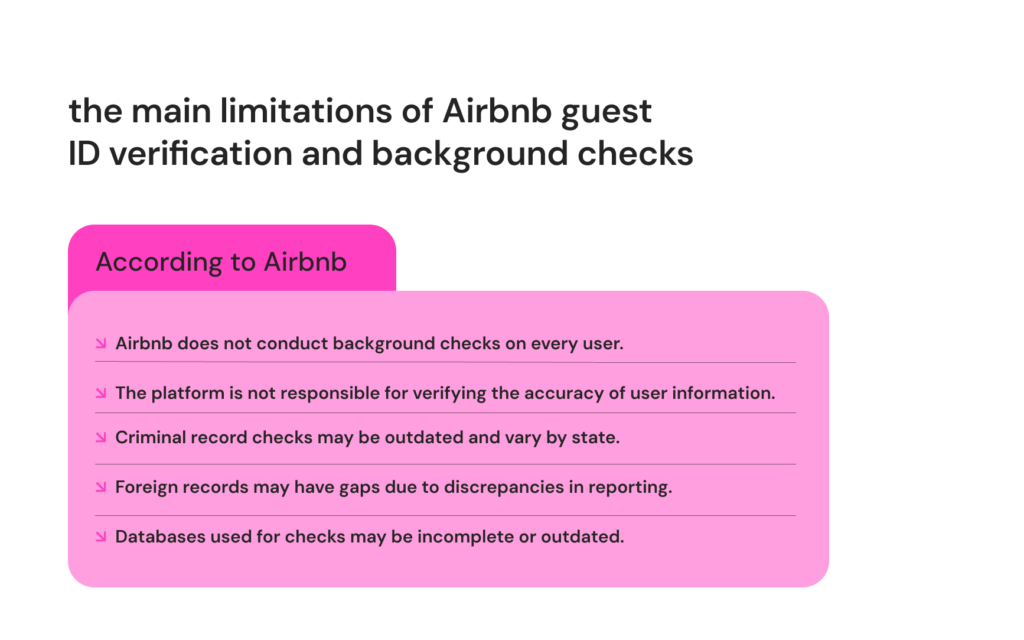
According to Airbnb, the main limitations of Airbnb guest ID verification and background checks are the following:
- Scope of search. Airbnb doesn’t run background checks on every user.
- User information accuracy. The platform is not responsible for the accuracy of information provided by users.
- Infrequency and inconsistency. The criminal record information Airbnb uses for checks may be several months out-of-date and vary by state.
- Differences between countries. Discrepancies in foreign records maintenance and reporting may result in informational gaps.
- Incomplete search results. The databases used by Airbnb may not include all records due to being outdated or legal limitations.
It all results in additional risks when renting out property. What if you confirm a booking, and it turns out the ID details collected by Airbnb don’t even belong to this person? The chance of a scam is higher than anyone would like.
Besides, there are some glitches and misunderstandings with Airbnb ID verification not working as expected. Hosts and guests frequently complain that they cannot validate an identity despite providing the necessary information.
“I’ve had many guests message me that they are having trouble uploading their ID and thus the booking does not confirm,” says Emilia42 from Orono, Maine.
All these limitations boil down to the need for Airbnb ID verification alternatives. Fortunately, there are many additional tools to use. One of them is Guest Screening and ID verification by Truvi.
Benjamin, CEO of HOLT, has implemented Truvi to minimize rental risks for a property management company:
“Truvi gives us an early look at someone who might not be fully honest and allows us to keep the calendars open for real guests. I also think the seriousness of how we present ourselves from the start, alongside signed rental agreements and Truvi’s portal, tells guests that we aren’t here to play games.”
Learn more details about HOLT’s experience with Truvi in the case study.
Why choose guest screening instead?
While Airbnb’s main goal is short-term property rental, guest screening platforms focus on protecting property managers from fraud. That’s what they specialize in and do best.
Even though Airbnb puts some effort into defending hosts, setting some safety rules, and collecting Airbnb security deposits, when things get really bad, it won’t help you. Here is only one of many stories like that:
“I had a couple stay, not a peep, once they left and deposit returned, they sent an email saying “We will POST this TERRIBLE Review” unless you refund us our stay. About 95% Lies (one part that was true was the couch had a stain on it…). I responded that I don’t do blackmail…sure enough she posted a terrible review. I called Airbnb and sent them the emails and they DID nothing. Nada.” recalls Rebecca B.
Cases like that are why property managers should use add-ons for guest screening. If the host from the story above had it, they might have learned some critical details about that couple and declined their rental request. Or, least, they would get instant reimbursement from the guest screening platform.
The Airbnb reimbursement process is too complicated and lengthy. You will need to negotiate for months and provide proof of damage, which is not always possible, like in the case of Jane P.
“I am a host and had a young couple with a toddler inquire about my home— supposedly moving from Tennessee to LA to start a new pool/construction business.
They left my place trashed. They took EVERYTHING. All my furnishings completely gone. They even took my fireplace. And they left it swarming with bugs from leftover food. I was in complete shock. This happened in January 2021 and Airbnb still has not paid me one dime. They wanted receipts which I did not have many of because the furniture was inherited from my husband who passed a few months earlier. I provided an itemized list with links for replacements for everything including prices. Still this was not acceptable and they rejected my claim.”
Truvi for guest screening
Truvi is an all-in-one risk management platform for property owners and managers. You can use it in addition to Airbnb to get extra protection in case of severe damage or fraud. And, of course, it has guest checks included, among other helpful features:
- ID Verification. After booking confirmation, your guest automatically receives a unique verification link to go through verification and upload their government ID card/passport photo and a real-time selfie.
- Guest Screening. We run background checks based on an internal guest database, phone number, email address, linked online profiles, IP address, VPN usage details, and data breach records. For US guests, there’s also the option of added sex offender and criminal records checks.
- Damage Protection. Our comprehensive damage protection plan can reimburse up to $1M in damages so you can do your rental business safely.
Understanding Airbnb’s verification gaps: why hosts need stronger protection
Airbnb’s ID verification process provides basic identity confirmation, but it’s not designed to be a comprehensive security solution for hosts. The platform’s own documentation admits significant limitations — incomplete background checks, outdated databases, and minimal guest information sharing with hosts.
While Airbnb verification catches some fraudulent accounts, it won’t tell you if someone has a history of property damage, fake contact details, or concerning behavioral patterns. For hosts who’ve invested significant money in their properties, relying solely on Airbnb’s basic checks leaves major gaps in protection.
The horror stories from hosts like Gillian and Jane aren’t outliers – they’re predictable outcomes when verification systems have acknowledged flaws. Smart hosts layer additional screening and protection on top of Airbnb’s basic requirements to catch problems before they become disasters.
Ready to screen guests beyond Airbnb’s basic checks?
Protect your property with Truvi’s Guest Screening and Damage Protection. Get detailed background checks, verify real identities, and secure up to $1M protection for any damage that occurs.
Check out pricing and get started today.