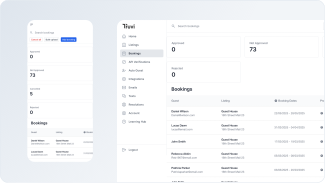

Screen & Protect API: Host Protection
Truvi Technologies Ltd (“Truvi” or “we”, “us” or “our”) provides a Screen and Protect Service to Hosts in relation to their Properties subject to these terms (as amended from time to time). Truvi screens Guests prior to their Booking commencing, and in the event of Property Damage, provides an Adjudication Service to fairly quantify Guest liability. In addition, where Guest liability is established, Truvi may exercise its discretion to make a Protection Payment to a Host in accordance with clause 7.1.
1. GUEST’S LIABILITY
1.1. No payments made by us under these terms shall release, reduce and/or waive any liability of a Guest relating to Property Damage.
1.2. Any payment by us under these terms automatically transfers and assigns a Guest’s liability such that it becomes a liability to us rather than to the Host.
2. HOST WARRANTY
2.1. Host agrees and warrants that they will not chase the Guest for any payment the subject of a previous discretionary Protection Payment made by Truvi to the Host, and if they receive any such payment, will notify us immediately, hold that payment on trust for us and make payment to the account nominated in writing by us.
3. CONDITIONS AND LIMITATIONS
3.1. For a Host to request a Protection Payment pursuant to these terms, the following conditions must be satisfied:
3.1.1. the Booking received an “Approved” status via our screening service;
3.1.2. all reasonable steps are and/or have been taken by the Host to mitigate the costs of any Property Damage;
3.1.3. the Host agrees to provide whatever assistance is required by us in order to:
a)assess the Property Damage; and
b) pursue a Guest for their liability.
3.2. Failure to meet the conditions set out in clause 3.1 may result in Truvi being unable to consider your Payment Request. However, compliance with these conditions does not guarantee that a Protection Payment will be made pursuant to clause 7.1, which will ultimately be determined by us in our sole discretion.
3.3. For the avoidance of doubt, Property Damage includes Accidental Damage or Malicious Damage or Theft.
4. EXCLUSIONS
4.1. We will not make any Protection Payment pursuant to these terms in respect of any:
4.1.1. unpaid Booking;
4.1.2. Booking for a Property located in a country that the UK Foreign and Commonwealth Office has determined is not suitable for travel on the day the Booking begins.
4.1.3. Acts of Nature;
4.1.4. Property Damage which cannot be proved to have been caused by a Guest during a Booking;
4.1.5. Cosmetic Damage or Wear and Tear;
4.1.6. Property Damage from any party which took place with the Host’s consent;
4.1.7. Property Damage which the Host could reasonably have expected or foreseen;
4.1.8. bodily injury or other loss suffered by a Host or Guest;
4.1.9. alternative accommodation costs for the Guest or Host;
4.1.10. interruption of business, loss of market and/or loss of use of the Property or consequential loss of income;
4.1.11. Property Damage which was caused by any pet (other than a service animal)
4.1.12. any maintenance of water amenities, including but not limited to hot tubs, pools, saunas; and
4.1.13. Infestation
4.2. Payment Requests will otherwise be determined in our discretion in accordance with clause 7.1.
5. REQUESTING A PAYMENT
5.1. In order to submit a Payment Request the Host must declare Property Damage to us within 30 days of the Guest’s check-out date (unless a different reporting window has been specifically agreed in writing), and thereafter present all requested evidence, which must include:
5.1.1. formal police reports of the event (as appropriate);
5.1.2. original Third-Party Invoices and/or receipts (where applicable); and
5.1.3. submission of the Host’s or the owner’s own home valid insurance schedule for the Property.
5.2. In certain circumstances we may require the Host to make an insurance claim before any Payment Request can be considered and retain the right to request timestamped photographs within 15 days of the Booking commencement date and after the Booking showing the Property Damage.
6. OUR ADJUDICATION SERVICE
6.1. The Host and the Guest will be given an opportunity to submit relevant evidence to the Adjudication Service before a finding is made in relation to the quantification of the Guests’ liability and the determination of any Charges All evidence requested by us must be received within 30 days of reporting Property Damage to us.
6.2. To quantify the Guest’s liability, we may take into account certain factors including but not limited to the following:
6.2.1. the cost of rebuilding or repairing the Property Damage to a condition equal to but not better or more extensive than the condition at the start of the Booking;
6.2.2. depreciation based on the expected lifetime of the item(s) within a rental environment, that has suffered Property Damage; and/or
6.2.3. any financial contribution which has been made towards the Property Damage by the Guest and/or any third party, including from the sale of any item which has suffered Property Damage and any relevant Damage Waiver or deposit.
6.3. The Host and the Guest acknowledge and agree that the decision of the Adjudication Service is final and binding upon them and constitutes the final determination of any Charges due and payable by the Guest in respect of the Booking.
6.4. This does not impact the right of the Host or the Guest to bring independent legal proceedings in respect of a Booking should they wish to challenge the final decision of the Adjudication Service.
6.5. For the avoidance of doubt, the determination of any Charges does not mandate the making of a Protection Payment, which is subject to clause 7.1 below.
6.6. The Host is entitled to a copy of all Adjudication Service evidence from us should they choose to pursue the Guest directly for any Charges. A request should be made in writing to [email protected] within 14 days of the decision of the Adjudication Service being communicated to the Host.
7. SETTLEMENT
7.1. The decision to reimburse the Host (and the amount of any reimbursement) in respect of Property Damage which occurred during a Booking shall be determined by us in our absolute and unfettered discretion. Protection Payments are made by us to Hosts on a unilateral and ex gratia basis.
7.2. Any Protection Payment made pursuant to these terms will be made by electronic transfer within five (5) working days of us agreeing to make any such Protection Payment.
7.3. Any Protection Payment made pursuant to these terms will be paid in the currency of the location of the Property Damage unless, in our sole discretion, we elect to pay the equal amount in a different currency. If currency conversions are required, we use OANDA (www.oanda.com).
7.4. For the avoidance of doubt, no Protection Payment will be made if such payment:
7.4.1. would breach economic, financial or trade sanctions imposed under the law of the country in which these terms are issued or have effect; or
7.4.2. would breach economic, financial or trade sanctions imposed by Canada, the European Union, United Kingdom, or the United States of America.
8. CHARGE RECOVERY
8.1. Upon the making of any Protection Payment, the Host agrees that the amount of the Charges due and payable by the Guest covered by that Protection Payment shall be automatically assigned to us and our account and that we may take ownership of the recovery process and may pursue the Guest in respect of the Charges in our own right.
9. GENERAL
9.1. These terms and any dispute or claim (including non-contractual disputes or claims) arising out of or in connection with them or their subject matter or formation shall be governed by and construed in accordance with the laws of England and Wales. The Host agrees to submit to the exclusive jurisdiction of the courts England and Wales.
9.2. The unenforceability or invalidity of any clause in these terms shall not have an impact on the enforceability or validity of any other clause.
9.3. Notices under these terms will be in writing and delivered by email.
DEFINITIONS FOR HOST PROTECTION:
“Accidental Damage” means unforeseen and unintentional damage to any Property, its fixtures and/or fittings, or its Contents caused by a Guest during a Booking. For the avoidance of doubt, this does not include wilful or deliberate action or inaction, Cosmetic Damage, Wear and Tear or Acts of Nature or Acts of War;
“Acts of Nature” means (but is not limited to) earthquakes and weather-related events such as hurricanes and tornadoes;
“Acts of War” means war, invasion, acts of foreign enemies, hostilities or warlike operations (whether war is declared or not), civil war, rebellion, revolution, insurrection, or civil commotion amounting to an uprising or usurped power;
“Adjudication Service” means a mechanism used by us to resolve Property Damage related disputes between Hosts and Guests and quantify the amount of any Guest liability as a Charge;
“Approved” means a status allocated by us to a Booking with no significant risks identified following Validation;
“Booking” means a confirmed stay;
“Business Day” means a day other than a Saturday, Sunday or public holiday in England when banks in London are open for business;
“Charges” means any lawful charges levied against the Guest in respect of their use of the Property during the Booking as determined by the Adjudication Service;
“Contents” means household goods and other personal property contained within a Property, including art, antiques and collectable items. For the avoidance of doubt, this does not include;
(a) animals including pets and livestock;
(b) currency, cheques, credit cards, postal orders, travellers’ cheques, money orders, crossed bankers’ drafts, current postage stamps, gift vouchers or tokens, customer redemption vouchers, travel tickets, precious metal in bullion form, notes, travel documents including but not limited to passports or securities;
(c) jewellery, watches, gemstones, handbags, furs;
(d) everyday household goods, homeware and decorations that exceed a reasonable value expected of that item when included in a short-term rental Property;
(e) single items, pairs, or sets valued new over £2500*,
unless in the case of b), c), and d) above, the items are stored in a locked safe inaccessible to Guests and do not exceed the value in (e).
*For the maximum payout equivalent in currency, see the table below.
| EUR | USD | CAD | AUD | ZAR |
| €3,000 | $3,500 | $4,500 | $5,000 | R60,000 |
“Cosmetic Damage” means damage that does not impact the likelihood of a Property receiving a Booking or adversely impact the functionality of the Property’s fixtures and/or fittings, or its Contents. By way of example (but not limited to) damage that consists solely of scratches, scuffs, marks or dents;
“Guest” means the lead guest who makes a Booking;
“Home Standards” refers to a set of standards and best practices that ensures a Listing is safe, fully functional and as advertised, including but not limited to:
(a) appropriate sleeping areas, hot and cold running water, and a functional sewage system;
(b) adequate protection of the property, including locks and/or other security devices (as appropriate); and
(c) functioning utilities, such as Wi-Fi, air conditioning and heating (as advertised).
“Host” (also “Client”) means an approved accommodation property advertiser who is advertising approved Listings on a recognised STR Platform;
“Infestation” means the presence of pests, insects, rodents, vermin, or other unwanted organisms in or around the Property in numbers or circumstances that constitute a nuisance, health hazard, or property damage risk. This includes but is not limited to ants, cockroaches, bed bugs, fleas, mice, rats, wasps, bees, birds, bats, or any other creatures that have established a presence beyond occasional, isolated sightings. An infestation is characterised by evidence of breeding, nesting, feeding, or other signs of established habitation, and typically requires professional pest control intervention rather than routine maintenance;
“Listing” (also “Property”) means any residential property (including to campervans, mobile homes, the dwelling itself and the immediate garden or yard directly surrounding the Property) that must be stationary during the whole Booking nor be transported to an alternative location prior to Booking commencement, which a Host has the legal and/or contractual right to offer to Guests and which complies with Home Standards. This includes only the dwelling itself and the immediate garden or yard directly surrounding the home. For avoidance of doubt, Property does not mean boats, floating structures, docks, dock stilts, detached outbuildings, pools, spas, recreational facilities or other water-based or non-residential structures;
“Malicious Damage” means damage that is not Accidental Damage;
“Party” means a social gathering of people who have been invited into the Property by the Guest(s), which typically involves eating, drinking, and entertainment, including any gathering where the number of Guests in the Property is greater than the Property’s stated capacity;
“Payment” (also “Protection Payment”) means any payment made by us in our discretion pursuant to clause 7.1 in response to a Payment Request;
“Payment Request” means a formal request for a Protection Payment to be made by us in accordance with these terms;
Property” see “Listing” definition;
“Property Damage” means damage caused to any Property, its fixtures and/or fittings, or its Contents, caused by the actions or inactions, whether accidental, deliberate or otherwise, of a guest (or any accompanying occupants) during a Booking. For the avoidance of doubt, this does not include Cosmetic Damage and/or Wear and Tear;
“Protection Payments” means any payment made by us in our discretion pursuant to clause 7.1 in response to a Payment Request;
“Services” means the Screen and Protect Services provided by us to the Host under these terms;
“Theft” means intentional stealing by a Guest from the Property during a Booking, as well as stealing that has occurred due to the actions and/or inactions of a Guest. For an incident of Theft to be the subject of a valid Payment Request under these Terms, the Host must submit to us proof of the existence of the Content in the Property before the Booking (such as timestamped pictures or Third-Party Invoices) and proof of the absence of the Content during or after the Booking (such as videos or timestamped pictures). We also require the Host to file a police report and submit that as evidence to us. In cases where the Guest is not the alleged thief but is presumably at fault due to negligence, the same evidence mentioned above is required, along with proof that the Guest agreed to take preventive measures. In certain circumstances, we may require the Host to make an insurance claim before any Payment Request under these terms for an incident involving Theft can be considered;
“Third-Party Invoice” means an invoice issued by an unaffiliated, independent third-party. Invoices issued by the Host, property owner, property management company, or any entity with shared ownership, control, directors, shareholders, or immediate family ties will not be accepted.
“Truvi” (also the “Company”) means Truvi Limited and/or any Group Company. Truvi shall also mean truvi.com and any other Truvi branded websites, web pages, mobile websites (collectively, the “Site”), and any mobile applications (the “App”) owned and or operated by Truvi;
“Validation” means the screening protocols and processes performed by us in order to allocate a status to any Booking;
“Wear and Tear” means the type of gradual deterioration to a Property’s fixtures and/or fittings, or its Contents which could reasonably be expected through normal usage over time.
2. Clause, schedule and paragraph headings shall not affect the interpretation of these terms.
3. A reference to a company shall include any company, corporation or other body corporate, wherever and however incorporated or established.
4. Unless the context otherwise requires, words in the singular shall include the plural and in the plural shall include the singular.