You get a booking request and look at the profile. A few reviews, maybe a photo with a “verified” badge. But something feels off, and you can’t articulate why. Ultimately, you need the revenue so you accept.
You just made a high-stakes decision based on almost no information.
The platforms have trained property managers to think this is normal. They say they “verify” guests, but what does that actually mean? They checked an email address at signup? They asked for an ID once, three years ago? You have no idea. They don’t tell you. You’re supposed to just trust them.
Most hosts don’t know this: after a platform verifies a guest at signup, that guest can change their profile details, including their name, to anything they want. The “verified” guest you’re accepting could have a completely different name on their profile than the one that was verified. The platform doesn’t re-verify or flag the change; they simply don’t tell you.
You’re trusting a verification that might not even match the person booking your property.
This is the system doing exactly what it’s built to do: maximize bookings. Limited information isn’t a bug: it’s what happens when systems optimize for conversion over verification depth.
They hold the verification data while you take the risk.
Why the Platforms Built It This Way
Before we go further, let’s be clear about something. The platforms aren’t villains here. They built systems optimized for their business model… it’s just that model is fundamentally different from yours.
Airbnb’s model requires frictionless booking, so every verification step threatens conversion rates and every flagged guest costs them a transaction. When your revenue comes from booking volume, you optimize for “yes” not “safe.” (And, to some extent, that’s rational.)
Their approach made sense when short-term rentals meant spare bedrooms with hosts present. Light verification worked when you were there to manage risk in real time. The trust model was peer-to-peer, neighbor-to-neighbor.
But the industry evolved and now property managers run portfolios across multiple cities, with assets worth hundreds of thousands of dollars. You’re managing risk for properties you might visit twice a year.
Frankly, these systems didn’t evolve with the industry. They’re still optimized for the original model: maximize bookings, minimize friction, and trust the marketplace to self-correct.
This creates misalignment. They need volume, while you need control of your business. And those aren’t always compatible priorities.
When a platform gives you limited screening information, that’s them protecting their conversion rates. When they don’t share why a guest was flagged elsewhere, that’s them protecting the guest experience. When claims take 30+ days with mysterious calculations, that’s them managing their own exposure.
They’re not wrong to optimize for their business, but you can’t optimize for yours when you’re dependent on their systems.
The Real Cost of Dependency
Our data tells us something most property managers don’t realize: between 10% and 15% of bookings have risk factors that platform verification doesn’t catch. If you’re doing 200 bookings a year, that’s 20 to 30 bookings with warning signs you never saw.
When damage happens, property managers spend an average of 8 to 12 hours per claim dealing with platform processes. 60% of claims take over 30+ days to resolve. When you finally get a settlement number, there’s no explanation of how they calculated it.
The average unrecovered damage cost sits between $800 and $1,200 per incident – and you’re absorbing these costs. You’re accepting the opacity as part of doing business.
But the real cost is strategic not financial.
When you don’t control who gets approved, when you can’t see the reasoning behind screening decisions, when you’re stuck in a black box claims process, you’ve surrendered control of your risk management.
When you’re uncertain about alternatives, you stick with what you know. One platform gradually becomes 50%, 60%, then 70% of your revenue, saying no gets expensive. You can’t push back on policy changes. You can’t negotiate. You just accept whatever they decide.
This dependency compounds. The more reliant you become, the less leverage you have. The less leverage you have, the more you accept unfavorable terms.
It’s a cycle that makes you increasingly vulnerable to decisions you didn’t make and can’t influence.
What Professional Risk Management Actually Looks Like
Hotels figured this out decades ago. Major hotel brands maintain shared databases of problem guests. When someone damages a Marriott in Chicago, that information protects a Marriott in Seattle. They share intelligence across their networks because they understand something fundamental: risk management improves with collective data.
Professional property managers deserve the same capability.
Real risk management has three components: intelligence, transparency, and control.
Intelligence
Intelligence means seeing the full picture:
- What verification actually checked – not just “this guest is verified” but what data points were confirmed and when.
- Context beyond star ratings – booking patterns, contact verification quality, whether this guest appears in databases of previous incidents.
- Network protection – when a property manager in Austin reports damage, that data protects a property manager in Nashville. When we identify a fraud pattern in Miami, everyone benefits.
This is a true network effect. The more properties using professional screening, the better the intelligence becomes for everyone.
Transparency
Transparency means understanding the reasoning:
- Clear flag explanations – not a vague “high risk” label but specific factors like temporary email address, unverified phone number, or booking patterns that match known fraud indicators.
- Visible settlement calculations – original value, depreciation based on age and use, repair versus replacement cost comparison, evidence quality assessment. Every line visible.
- Accountable both ways – if you disagree with something, you can see exactly what was applied and discuss it.
Transparency creates accountability on both sides.
Control
Control means you make the final decision:
- Your judgment matters – maybe you’re comfortable with a flagged booking because the guest explained their situation and you believe them.
- Your standards apply – maybe you want to auto-reject anything flagged because you manage high-end properties for particular owners.
- Your property, your call – intelligence informs you, you decide.
This is how professional operators in other industries manage risk. Hotels work this way. Corporate housing works this way. Car rental companies work this way. They have data, they have transparency, they maintain control.
Short-term rental property managers should have the same tools.
How This Works in Practice
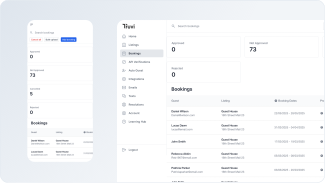
At Truvi, we built our screening and protection around this model. Every booking gets screened in seconds against our network’s watchlist, contact verification databases, behavioral pattern recognition, and required registry checks for regulatory compliance.
You get a clear result: Approve, Flag, or Reject. But more importantly, you see exactly why.
Not “this guest is verified” with no details. Instead: “Flagged because email is temporary, phone unverified, and booking pattern matches fraud indicators we’ve identified across our network.”
Or: “Approved. All checks passed, verified contact information, no flags in our system.”
Or: “Rejected. Guest appears on our watchlist for property damage in Denver, reported four months ago.”
You see what we see. Then you decide what to do with that information.
When damage happens despite screening, the claims process is equally transparent. You submit evidence and see your evidence score in real time across five clear categories. If something’s missing, we tell you exactly what to add. We’re not looking for reasons to reject legitimate claims.
Settlement calculations show every step. You can see the depreciation we applied, the repair versus replacement analysis, how evidence quality affected the final number. Average resolution time in our system is under seven days. Most straightforward claims settle within 48 hours.
Compare that to the 30+ day average with platform claims processes.
The transparency serves everyone. Property managers know exactly what protection they have. When they show owners the screening reports and claims documentation, those owners understand the value. That’s professional property management, not “the platform verified them so we’re good.”
Our system also handles regulatory compliance automatically. Arizona requires criminal background checks. San Francisco is considering sex offender registry screening. Denver has specific requirements. Many HOAs and insurance policies now require documented screening.
With professional-grade screening, you’re automatically compliant. We screen to the highest standard, document everything, and give you records if anyone asks. Your insurance company wants proof you’re screening? You have it. HOA requires background checks? Done. City inspector asks about compliance? You can show them immediately.
You’re not trying to decode regulations or hope you’re meeting requirements. It’s handled.
Building Independence
When you have your own screening and protection infrastructure, you can take bookings from anywhere. Airbnb, Vrbo, Booking.com, direct bookings, corporate clients. You’re not locked into one platform’s ecosystem or dependent on their changes.
You can build a genuinely diversified revenue base where no single channel controls more than 30% of your business. That’s when you have real negotiating power. That’s when policy changes from one platform don’t threaten your entire operation.
Control over your risk management creates strategic options because you can evaluate new booking channels based on distribution reach and commission rates, not whether their protection programs are adequate. You can pursue corporate contracts and direct booking relationships with confidence and can grow your portfolio knowing your risk management scales systematically.
One property manager in Charleston told us the transparency in screening changed everything. She’s not second-guessing herself anymore because she sees exactly what the risks are and makes informed decisions. For the first time in five years, she feels like she’s managing risk instead of hoping for the best.
Another operator in Portland showed his property owners the screening reports and they immediately understood the value. One owner agreed to a higher management fee because he could demonstrate professional-grade risk management. That’s the difference between being a platform-dependent contractor and running an actual business.
This matters for scaling too. When your risk management is systematic and data-driven, you can confidently add more properties. You’re not scaling chaos and hoping it works out. You’re scaling a professional operation with consistent standards.
Where This Goes
We’re building toward an industry where property managers aren’t dependent on any single platform for risk management. Where you have professional-grade intelligence to make your own decisions. Where claims are resolved fairly and quickly with complete transparency. Where regulatory compliance is automatic. Where you can grow your business on your terms.
Use the platforms for what they’re good at: distribution. Airbnb has guests. Vrbo has guests. Booking.com has guests. Take advantage of that reach. But don’t let any one channel control your risk management or become more than a third of your revenue.
Build your business on intelligence and control, not hope and dependency.
As our network grows, everyone benefits. More property managers means better screening data. More bookings mean smarter algorithms. More claims mean fairer, faster processes. The intelligence compounds. The protection improves. Your independence strengthens.
The industry normalized this. Limited visibility became “just how it works.” Professional operators are realizing they don’t have to accept either.
When you control the risk, you control your business.
The platforms have their model. You should have yours.
Truvi’s Guest Screening and Damage Protection give you the intelligence and transparency to make your own decisions.
Check out pricing and go live today.