How to Scale an Airbnb Business: From a Single Property to Multiple Listings
The short-term rental market is growing at 11.12% annually, which means there’s real opportunity in Airbnb investing. Simple math: more properties usually means more income.
Growing from one Airbnb to multiple properties can transform your side hustle into serious income. But scaling isn’t always smooth — hosts often rush to add properties, make poor investment choices, or ignore seasonal patterns. Here’s how to scale your Airbnb business successfully, with strategies from hosts who’ve built multi-property portfolios.

Signs it’s time to scale your short-term rentals
Before looking at how you can scale your Airbnb business, make sure you’re actually ready. Here are some evident signs it’s a good time to launch more rentals.
It’s working, and you know how
Experienced hosts recommend getting to grips with your first property before adding more. One experienced host emphasizes the importance of patience before scaling:
“Get to know your seasons. What’s the market like? How many competitors? Are they booked, and if so, how far out? Can you carry a mortgage if the booking drops?” Bob_12_Pack
Take time to master the fundamentals and understand your market dynamics before expanding to property number two. Make sure your first Airbnb is actually profitable by tracking expenses, income, and seasonal patterns. Test different strategies, learn from your reviews, and fix any issues. Master the basics of how to start a short-term rental business before adding property number two.
What to know before scaling:
- Potential income and ROI
- Legal limitations on the number of rentals
- Time and cost spent on property maintenance
- Demand and occupancy fluctuations
- Common guest issues and requests
You’re ready to be more involved
Each new property means more cleaning, guest communication, and admin work — at least until you automate things (more on that below). Before scaling, honestly assess how much time you can commit. Turnovers can take 4 hours per property, property damage needs immediate attention, and guest issues don’t wait. Scaling often means going from side hustle to part-time or full-time work.
Occupancy has been high for a while
High occupancy — around 70-80% — shows strong demand in your market (no property books every night of the year). If you’re consistently busy, that’s a green light to consider property number two. Figure out what’s working and replicate it.
How to scale your Airbnb business: 7 top approaches
Scaling means treating your rentals like a real business. You’ll need to budget carefully, streamline operations, and think strategically. Here are seven strategies that work for growing Airbnb portfolios.
Calculate and choose new places wisely
Run detailed financial projections on every potential property — projected income, renovation costs, furniture, ongoing expenses.
Many short-term rentals aren’t profitable once you factor in mortgage payments, especially with current interest rates. As one host puts it:
“To scale you’ll need capital, a good plan on finding a profitable one, and an ability to hire and manage effective people to help you.” mirageofstars
Be strategic and selective rather than rushing to expand.
Research each market thoroughly — average rates, occupancy, seasonality, and regulations. Cities like Chicago, Los Angeles, and Las Vegas have a primary residence requirement, which means you’ll need to live in the property you list. Others cap annual rental days. These rules can make or break your expansion plans.
KPIs to measure before launching an Airbnb:
- Average nightly rate in similar listings
- Local occupancy rates
- Average annual revenue
Automate messaging
Start simple with templates for common messages — booking confirmations, check-in instructions, local recommendations, and follow-ups. Create them once, then customize slightly for each guest.
Property Management Systems (PMS) like Guesty, Hospitable, and OwnerRez take automation further, handling the most common guest communication automatically. That usually includes things like booking confirmations, pre-arrival instructions, and check-in/out details.
Here’s how to set it up:
Step 1: Create personalized templates. Add placeholders for guest names, dates, and property details to make each message feel custom.
For example:
Dear, {{Guest First Name}}
Thank you for choosing our place for your stay!
Your booking for {{Check-In Date}}, {{Check-Out Date}} is confirmed.
We are looking forward to meeting you at {{Listing Address}}.
Let us know about any questions or special requests you may have.
Step 2: Set up triggers. Tell the system when to send each message — 3 days before arrival, after check-in, etc.
Step 3: Test and improve. If guests keep asking the same questions, your templates need work. Refine until communication flows smoothly.
Establish SOPs (Standard Operating Procedures)
Document every task you do to run your rental — cleaning protocols, guest communication, maintenance checks, everything. With one property, you can wing it. With multiple properties, you need systems or things fall through the cracks.
SOPs ensure consistent service across all your properties. They also make it easier to hire help or find software to handle routine tasks.
Key tasks with short-term rentals:
- Property cleaning
- Changing linens and laundry
- Restocking toiletries and consumables
- Taking out trash
- Checking for and reporting damages or missing items
- Resetting thermostat and smart home settings
- Ensuring all appliances are working
- Guest communications
- Requesting and leaving reviews
- Booking request management
- Pricing updates
- Monthly or quarterly maintenance checks
- Accounting and paying taxes
- Paying cleaning staff or contractors
- Monitoring local STR market
- Updating listing photos and descriptions
- Maintaining permits, licenses, and insurance
- Testing listing updates and optimization
Use dynamic pricing tools
Dynamic pricing tools analyze demand, competition, local events, and trends to set optimal rates automatically. Tools like Pricelabs, Wheelhouse, and Lodgify Dynamic Pricing adjust your prices across all platforms based on market conditions.
Manual pricing can work well if you prefer control over your rates. For instance, one host explains an approach that works for them without deploying dynamic pricing:
“I have a price for peak season and a price for off-season, and rarely adjust more than that. For me, I’m not that desperate to fill small gaps between stays in an effort to reach peak optimancy, so I just stick with the same rate.” TastyMorsel1
Though this approach, which involves trial and error initially, might make sense for smaller portfolios, it becomes overwhelming as you scale.
Connect ID verification software and use other security measures
Don’t just focus on profits when scaling — security matters too. Airbnb’s ID verification and background checks have gaps, and horror stories of property damage are common. More properties mean more risk, so you need better screening tools.
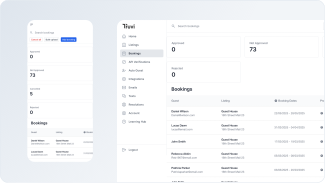
Services like Truvi combine Guest Screening — name, email, and profile checks, ID verification, and criminal and sex offender checks — with Damage Protection. You’re filtering out problematic guests and getting covered if damage happens.
“Having a guest screening and immediate response, whether or not they’re verified, and having that automated system notifying us of what we need to do, like respond back to them and ask for further details, was a real game changer for us.” Oliver Harper, Founder of Harper Luxe
Check out our short-term rental insurance guide for more protection strategies.
Consider hiring people
With 3-4 properties, automation might be enough. But once you hit double digits, you’ll need to hire help. One host explains their approach:
“At about 20 listings, it’s worthwhile to bring in a handyman full-time. Also, a cleaning person with hotel experience that can train, oversee, and do quality control on your housekeeping staff. Start to get employees to handle most of the day-to-day so you can focus on marketing and building a brand.” Oskyguy
Many hosts and real estate specialists also start to cooperate with property management companies when scaling, bringing in someone to organize rentals, manage accounting, pay taxes, and handle other chores across multiple properties:
“Managing it yourself gives you a low-paying job for which you must be an expert in multiple skill sets. These skill sets include marketing, legal, accounting, repair, and 24-hour customer service. For all that, you get 8 to 10 percent of the rent, which will be taxed.
Hiring a management company does not completely fix everything. But what hiring professional managers does for you is allow you to take on several rentals at a time, rather than just 1 or 2. In fact, with a good manager, you could grow about as many properties as you want without increasing your own workload too much.” Dave Merk, Real Estate Investor
Schedule tasks for yourself or team
Track every task in one system — missed cleaning details can cost you 5-star reviews. Property management software makes task scheduling manageable, whether you’re scaling your first few properties or managing dozens. The choice of software will depend on your STR business volume:
“The ‘best’ software will ultimately be determined by the needs of the user. Software and apps in the short-term rental business is all about balancing needs with budget. If you’ve only got a handful of properties, you don’t need an enterprise solution that has a $20k onboarding fee.” Michael Skinner, Professional Vacation Rental Manager
Here’s how automated task management works: booking confirmations trigger cleaning schedules, check-outs create maintenance tasks, and new inquiries generate follow-up reminders. Your team gets access to the same calendar, so everyone knows what needs doing when.
Automated scheduling lets you manage more properties without dropping balls — no more double bookings, forgotten cleans, or ignored guest messages.
Common scaling mistakes (and how to avoid them)
Scaling your rental empire might be the goal, but it comes with increased risk. Here are some of the most common pitfalls to be aware of, along with some troubleshooting tips.
Regulatory limitations
Ignoring regulations can mean heavy fines or getting banned entirely. Some markets just aren’t scalable due to strict rules. Local Airbnb laws often limit how many properties you can list, cap annual rental days, or restrict rentals to specific zones. You might need licenses that require yearly renewal. These rules can kill your scaling plans and profitability.
Tip: Learn the local regulations before investing in opening a new rental property. Consult with professionals.
Excessive load and burnout
Many hosts try to manage multiple properties the same way they handled one — doing everything themselves. They clean all the units, handle every guest message, and manage all the logistics until they’re completely burned out. The problem isn’t that they’ve failed; they just need better systems.
Tip: Write out standard operating procedures and test different tools to optimize processes before scaling rentals.
Seasonal fluctuations and a drop in demand
Scaling without understanding seasonal patterns is risky. During slow months, utilities and maintenance can cost more than you’re earning. Some years are just tough for short-term rentals. You need to constantly monitor your market and adjust strategy, or you could lose money.
Some hosts switch to long-term rentals for stability, even though the income is usually lower:
“For us, long-term rentals bring in a lot more money, and it’s steady money. We know a year in advance how much we’re getting each month. With Airbnb, we don’t know until the month is over.” Eileen Wood
Tip: Choose locations with stable demand or multiple high-demand seasons. Research seasonal patterns thoroughly before investing. You can manage direct booking listings remotely to expand your reach.
Hidden costs
New hosts often underestimate scaling costs, especially if their first property was inherited or a furnished room in their own home. When they buy or finance their second property, they’re surprised by expenses like furniture replacement, licensing fees, and major repairs:
“A rule of thumb I picked up from my dad (who was an entrepreneur) is assume that it will cost twice as much and take twice as long for your assumed revenue to materialize.
Also, keep in mind how fickle Airbnb can be. Especially since you seem like new hosts, this is an even bigger risk since there are plenty of landmines which can destroy your Airbnb listing. You can diversify your risk a bit by listing on Vrbo, Booking, etc., but Airbnb is still king, and I don’t see them going down anytime soon.” HelloWorldMisericord
Tip: Be ready that something will go wrong, and carefully calculate your budget before starting. Have some extra money for unexpected expenses.
Scale smart, scale protected
Scaling your Airbnb business from one property to multiple listings can transform your income, but success depends on getting the fundamentals right. Start with a profitable first property, understand your local market and regulations, then build systems that can handle growth.
The hosts who scale successfully don’t just add more properties — they invest in automation, guest screening, and damage protection services from the beginning. Modern tools make it possible to manage multiple properties efficiently while maintaining quality and protecting your investment. With the right approach, you can turn your short-term rental side hustle into a thriving business that generates serious income.
Ready to scale your Airbnb business with confidence?
Protect your growing portfolio with Truvi’s Guest Screening and Damage Protection. Screen guests before they book and get up to $1M coverage for any damage that occurs.