

Anyone can start short-term rentals by creating a listing on Airbnb. Yet, not everyone can turn rentals into a profitable business that generates steady profit. Hosts often focus on high occupancy, dumping the rates. Alternatively, setting prices too high can lead to prolonged vacancy periods. How do you make sure you have the right pricing strategy? One option is to hire an Airbnb revenue manager.
Short-term rental revenue management professionals know the local market and how to maximize Airbnb profit. They can analyze your listing performance, competitors’ offerings, and rental trends to understand optimal rates.
Learn more about the responsibilities of an Airbnb revenue manager and how they can benefit hosts in our overview. We also share advice on where to look for a revenue manager and how to increase Airbnb revenue.
Who is a revenue manager?
If you feel like outsourcing STR revenue management, there is a dedicated specialist for that. A revenue manager analyzes booking metrics, competitor rates, and the local market to build a pricing strategy that drives profit. They can do it manually or use short-term rental revenue management tools like PriceLabs or Beyond. A revenue manager can have access to your accounts to set prices and configure minimum and maximum rates, duration of stay, and demand sensitivity.
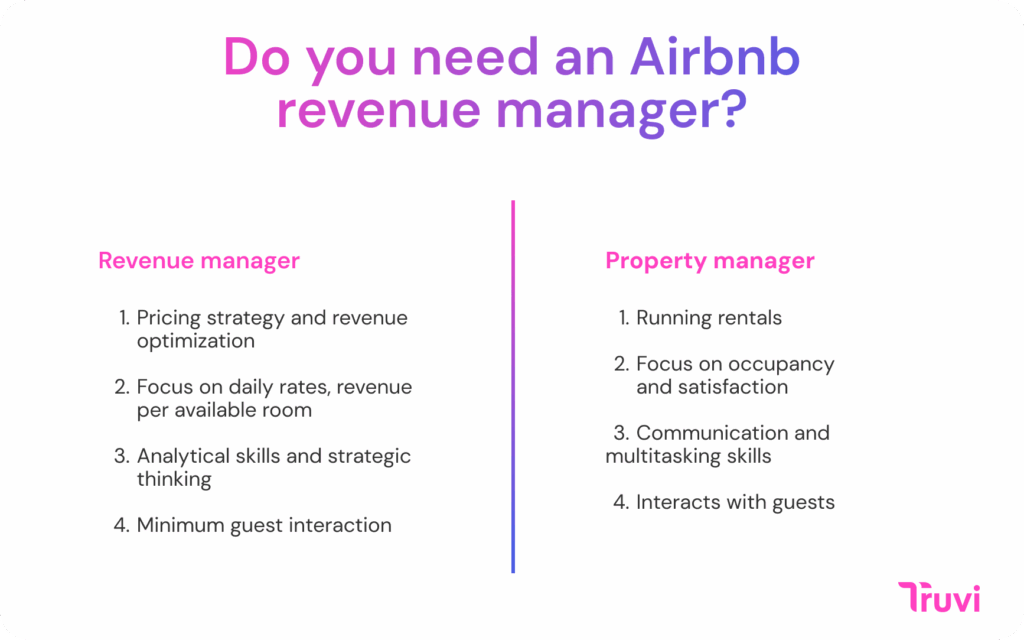
It may be a separate person from a property manager or a property manager who combines two roles. The key benefit of using professional short-term rental revenue management services is experience. You get someone who knows the market in and out and can help design an effective pricing strategy.

What does a revenue manager do?
If you’re looking for a brief answer, an Airbnb revenue manager can help increase your income. They analyze whether short-term rentals are profitable and develop a personalized pricing strategy. Revenue management may seem like something easy to do, but in reality, it requires years of experience and profound analytical skills. An Airbnb revenue manager does many tasks, including:
- Developing a pricing strategy. A revenue manager analyzes your current Airbnb KPIs to see where you fail and where you can do better. They rely on personal experience and local rental market knowledge to offer a more effective pricing approach, taking into account seasonality, demand fluctuations, competition, and many other factors.
- Balancing supply with demand. They continuously monitor the demand to see when to raise or lower rates. High rates don’t always harm occupancy, but you must know the right time to bump up.
- Setting short- and long-term revenue goals. Revenue managers discuss with hosts what they want to achieve and plan how to do it. You may not be able to achieve the highest revenue right away, but with the right pricing, improved pictures, more positive guest reviews, and other effective tactics, you can gradually grow your profits.
- Performance analysis. An Airbnb revenue manager tracks the performance of short-term rentals to see whether the adopted pricing strategy yields the expected results. Choosing an optimal strategy requires a lot of testing and continuous improvement.
- Competitor monitoring. They check the rates and occupancy of similar listings to see whether you are at the same level and adjust pricing accordingly.
- Forecasting. Revenue managers forecast the demand, occupancy rates, and revenue based on historical data and trends. It helps hosts predict their income and better manage their budgets.
- Reporting. Airbnb revenue managers regularly provide hosts with reports tracking property performance. Reporting also allows you to make sure investment in hiring a revenue manager pays off.
- STR channel management. Most STR revenue managers request access to Airbnb, Vrbo, and other booking accounts to manage prices and gather analytics directly. They adjust listing availability and pricing to improve earnings.
Sounds like a lot, right? You can manage vacation rental revenue yourself, but be ready to dedicate substantial time to it. In most cases, hiring an Airbnb revenue manager or at least using a specialized pricing tool is a more efficient option.
When do you need an Airbnb revenue manager?

Hiring a revenue manager is not mandatory. Do it after reaching a certain point in short-term rentals when manual property management is no longer feasible. Amateurs with one property or occasional rentals can handle pricing on their own. However, it becomes much more challenging when you have multiple properties or face complex market conditions, like working in the luxury property segment.
You should also consider hiring an external expert if you have high occupancy but low revenue. An Airbnb revenue manager can help you increase nightly rates without losing bookings. Another common reason to cooperate with a revenue manager is to analyze the market potential before opening more rentals. If you view rentals as an investment, revenue management professionals can help you calculate ROI, predict revenue, and kick off with the right pricing strategy. Finally, you may decide to hire an Airbnb revenue manager if you just don’t want to monitor pricing. You may be too busy or hate analytics. Not wanting to do something is a strong reason to outsource it.

Other options for Airbnb revenue management
Hiring a dedicated person is not the only way to enhance short-term rental revenue management. There are specialized tools that can also guide you on how to maximize Airbnb profit. Additionally, Airbnb and other booking platforms offer built-in smart pricing functionality you can use for more personalized and demand-driven rates. Let’s review the key alternatives to partnering with a revenue manager:
Specialized revenue management software
These are add-ons you can connect with booking platforms and other property management software to upgrade price management. Pricelabs, Lodgify Dynamic Pricing, and Beyond are the most popular options, but the choice is much broader. These tools automatically monitor other rentals and use dynamic pricing algorithms to set prices for your listings. They evaluate demand and supply, consider local events that can attract more visitors, and analyze the performance of your listings to determine the best rates. With a revenue management tool, hosts can sometimes get several hundred dollars more per night than they would charge otherwise.
In our guide on vacation rental revenue management, we share steps to choose a suitable automated tool and tell more about how it works.
OTA platforms with built-in pricing features
OTA platforms do have some tools to assist hosts with revenue management. You can use Smart Pricing on Airbnb, MarketMaker on Vrbo, or Price Performance Dashboard on Booking.com. These tools automatically adjust nightly rates based on the demand and other factors in your location. They also allow you to compare prices with competitors to make sure you charge enough. However, the tools by OTA platforms have limited functionality and personalization. They put anyone in equal conditions, so don’t expect to outperform other listings with such basic functionality.
Manual tracking
You can use online resources like AirDNA to gather market insights and adapt your revenue management strategy manually. This data is free and far from perfect, so don’t expect granularity. Many property owners also manually check the rates set by other listings. This approach gives valuable information, but it’s too time-consuming, and the rates change too frequently. That’s why manual revenue management can work only if you have one or two listings.
Airbnb revenue manager vs. pricing tools
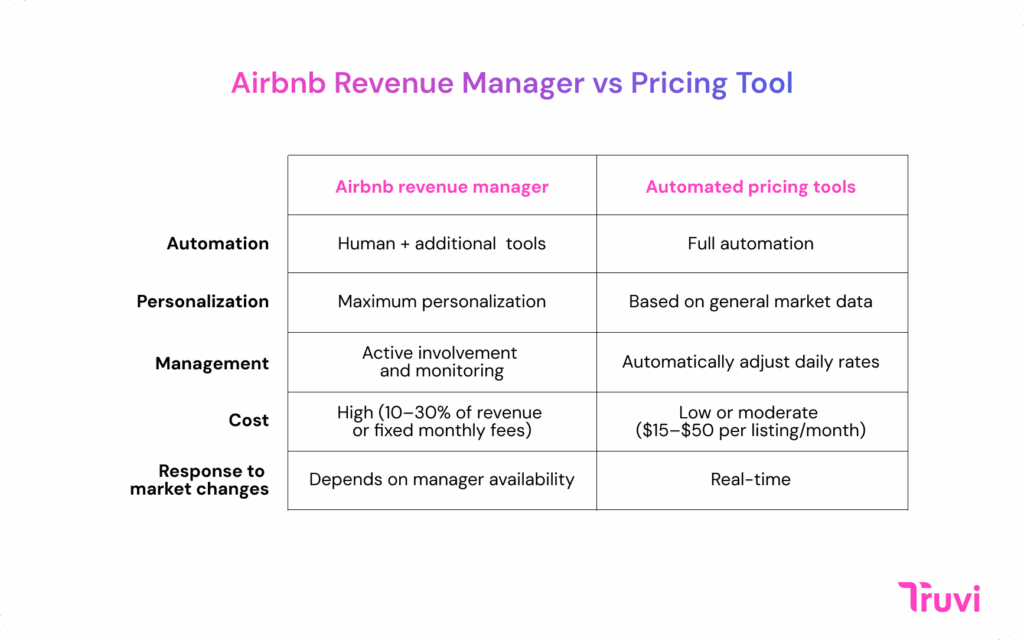
Since built-in Airbnb features and manual tracking are the least effective revenue management options, you’ll likely choose between hiring a revenue manager or using specialized pricing tools. Below, we compare these options in more detail to help you make an informed decision.
Airbnb revenue manager
By working with an Airbnb revenue manager, you benefit from a combination of personal expertise and reliable data. Managers use pricing tools for data analytics as well, but they have years of experience to determine when automatically offered rates can be improved. They also build a personalized strategy on how to increase Airbnb revenue based on your unique case.
Pros:
- Personalized revenue management strategy
- Local events, holidays, trends, and other unexpected factors are considered
- More comprehensive services that also include minimum stay optimization, discount policies, cancellation rules, etc.
- Higher potential profits
Cons:
- Charges for rental revenue management are much higher
- Not the best option for hosts with 1-2 rentals
- Dependence on the Airbnb revenue manager’s skills
Best for:
- Hosts with over 5 listings
- Luxury properties that require a more custom approach
- Maximizing revenue
Specialized pricing tools
Automated revenue management tools integrate with your existing software, including Airbnb, to adjust pricing. Since many hosts use such software, it cannot give you a considerable competitive advantage. However, it can help you feel more confident when raising nightly rates and provide real-time market data. Most importantly, you can fully automate price management.
Pros:
- Lower cost of short-term rental revenue management
- Full automation with custom rules and settings
- Easy to scale and manage more listings
- Suitable for hosts with 1-2 listings
Cons:
- No personalization and generic approach that doesn’t take into account unexpected events
- Potentially lower revenue
- No long-term strategy and advanced analytics
Best for:
- Hosts who have limited budgets
- Managing 1-3 listings
- Maximum automation with minimum involvement
How to find a good revenue manager?
If you read this section, you have probably made up your mind regarding hiring an Airbnb revenue manager or, at least, seriously considering this option. Finding the right person is crucial to achieving a good result. Someone inexperienced or underqualified won’t be able to run a proper market analysis and set competitive rates. Here are the steps and tips to select an Airbnb revenue manager.
1. Define the scope of services
Determine what short-term rental revenue management services you need. One-time help or ongoing management? Revenue management consulting or comprehensive services? Your needs will determine who you should look for. Different candidates will offer different services and extent of involvement.
2. Look for candidates
Ask your fellow hosts for recommendations if they ever worked with an Airbnb revenue manager or browse online resources like Upwork, Fiverr Pro, and Toptal. Reddit, Facebook, and other social media platforms can also help in finding candidates. You don’t need dozens of options. Select 3-5 candidates who really meet your requirements in terms of skills and rates.
3. Have interviews
Meet several candidates in person, as gut feeling matters a lot. Even online interviews are better than nothing. Prepare a list of questions to evaluate their key competencies, like the following ones:
- What are the key factors that affect STR nightly rates?
- How many listings can you manage at the same time?
- What do you know about my area, seasonality, and local events that affect demand?
- Do you use revenue management tools? Which ones?
- How often will you provide reports?
- What are your results with other listings?
- Can you give a link to reviews by other clients?
4. Sign a contract and set goals
Specify the terms of cooperation and sign a contract, listing property details, goals of cooperation, scope of provided services, fees and payment terms, performance indicators and other KPIs (if applicable), tools and access, and contract duration and termination clauses.
Once you start working with an Airbnb revenue manager, keep a close eye on it for a few weeks. Monitor the implemented changes and discuss an overall strategy to make sure the adopted approach is what you need. No need to micromanage. Just check whether you are all going in the right direction.
Cost of hiring an Airbnb revenue manager
The cost of professional revenue management depends on the type of services and location. You need to talk to potential candidates directly to get a quote and learn more about what they offer.
Generally, most Airbnb revenue managers charge a percentage of the gross revenue, typically ranging from 10% to 30% for full-service property management, or a flat monthly fee. The fees range from $50 to $250 per listing per month. $50 is for basic pricing management, while $250 is charged for a personalized approach with regular reporting.
Expert advice: How to increase Airbnb revenue
An Airbnb revenue management strategy is more than just changing prices based on demand. There are many things you can do to increase revenue, from adjusting the minimum night stay to getting short-term rental insurance. Read more tips on how to maximize Airbnb profit below.
Use dynamic pricing tools
Tools like PriceLabs, Beyond Pricing, or Wheelhouse automatically update prices in response to real-time market changes. It considerably optimizes revenue management and helps both property owners and professional revenue managers focus on more strategic tasks. You may fully automate price management or use it partially, keeping control over daily rates.
Adjust minimum night stay
Adapt the duration of minimum stays to demand. When the demand is lower, it’s better to allow shorter stays to attract potential guests. When the competition for nice listings is high, you can be more picky and increase the number of minimum stays to generate more revenue per booking.
Offer lower rates for last-minute bookings
If no one has booked your property for the upcoming days, offer a discount. A slightly lower rate is better than a prolonged vacancy period. Just don’t go too far, and make sure the rate is still enough to generate profit. Similarly, you can charge higher rates for bookings made far in advance.
Protect property with short-term rental insurance
Short-term rentals result in significant wear and tear, and the risk of property damage is pretty high. If you don’t protect the property and hold guests accountable for their actions, expenses will start to pile up. That’s why you need damage protection services to cover accidental and malicious damage. Besides, STR insurance is required by some local regulations, and you must have it to avoid penalties.
Implement guest screening
Automated guest screening is another way to minimize financial losses from short-term rental damage. The damage protection services by Truvi support guest screening as an essential component of shielding your property. The tool checks guests against multiple reliable databases and flags suspicious accounts. This way, you can make sure only good people enter your place and avoid unplanned expenses.
Subscribe to local social media groups
Find local groups on social media to keep up with events that may attract guests and impact occupancy. You should also track what festivals, business gatherings, shows, and other activities are taking place. It will enable you to adjust your Airbnb revenue management strategy accordingly and increase rates on days when demand is high.
Summing up
Hiring an Airbnb revenue manager is a good idea for property owners who run multiple properties and struggle to set the right prices. You can do a lot on your own, but cooperation with a professional is irreplaceable. Even several consulting sessions with an experienced revenue manager can help you adjust daily rates and earn more. Despite being a promising niche, Airbnb rentals require strategic management and planning, so you need a data-driven pricing model for maximum revenue.